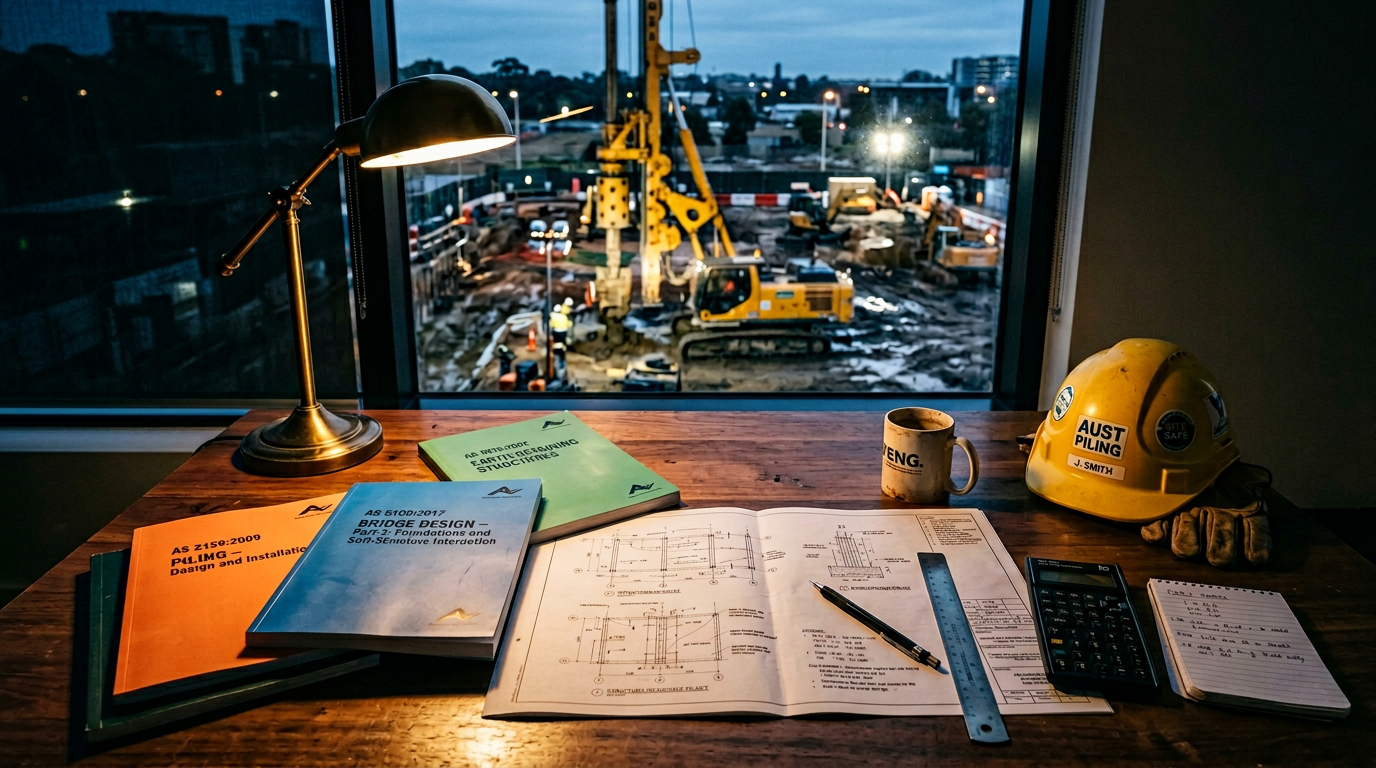
Piling work in Australia is governed by a small family of Standards. You do not need to memorise every clause — but you do need to know which Standard applies to which part of your job, because mixing them up is the fastest way to fail an audit. This article is the short version that we hand to new graduates and junior site engineers on day one.
1. AS 2159:2009 — Piling: Design and Installation
Scope: all conventional piling in Australia — driven, bored, screw/helical, sheet and composite — outside of bridge piers and retaining walls covered by dedicated Standards.
Key clauses to know by number:
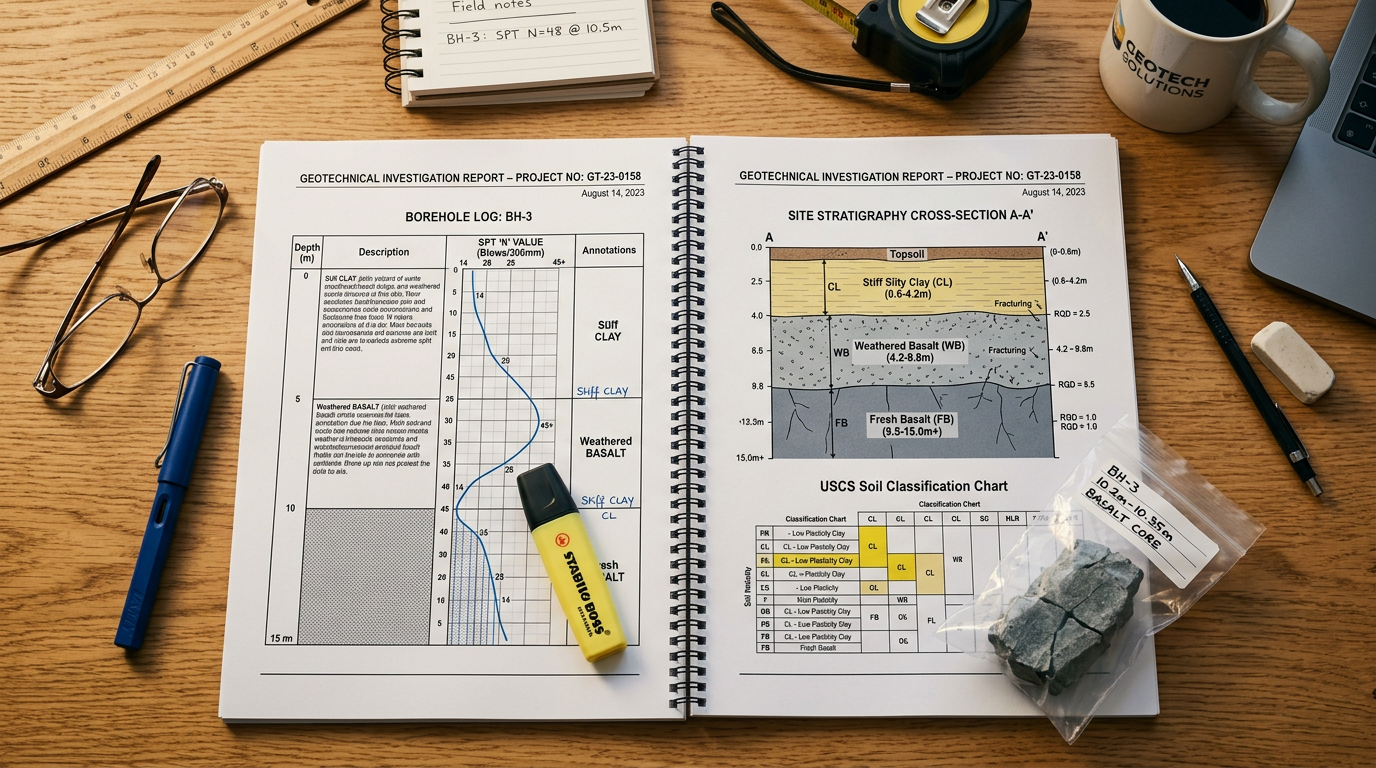
- Section 4 — Geotechnical investigation. Defines the minimum investigation required before you can design a pile. The phrase “adequate geotechnical investigation” in a design report means this section.
- Section 5 — Design: Ultimate and serviceability states. The limit-state framework. This is where Φg, the geotechnical strength reduction factor, lives. Φg is not a single number — it is derived from an explicit risk assessment based on the site investigation, the designer’s experience with the pile type, and the intended testing regime. A design that writes “Φg = 0.7” without showing how you got there will not pass peer review.
- Section 6 — Design: Structural capacity. The structural limit state for the pile shaft itself. Concrete or steel stresses, reinforcement, buckling checks for slender piles.
- Section 7 — Installation. Minimum installation records: concrete volumes, cage depths, torque-vs-depth for screw piles, drive records for driven piles.
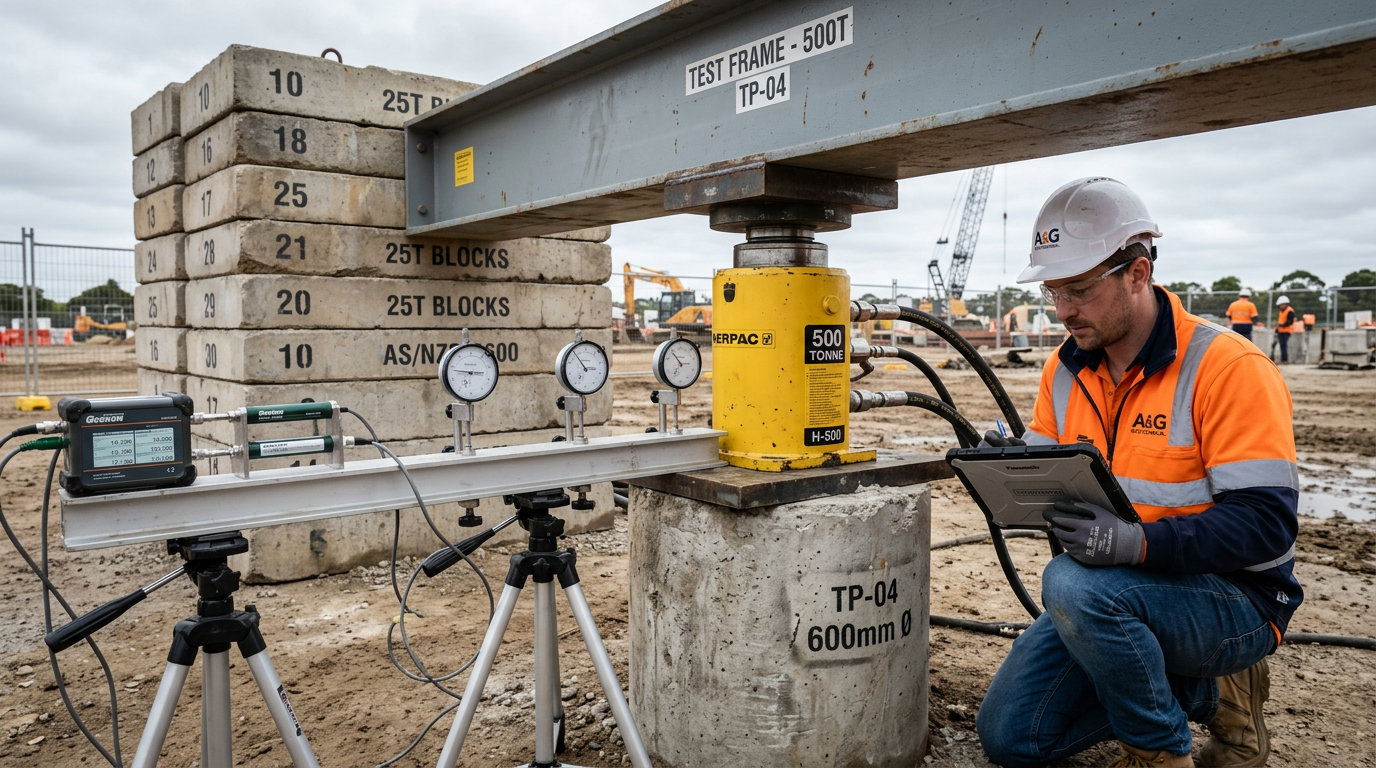
- Section 8 — Pile testing. Static load tests, dynamic (PDA) tests, integrity tests. The test reduction factor Φt is applied here — more testing unlocks higher design capacity.
Common failure mode: designers adopting a low Φg because of scarce site data, and the contractor then arguing for a higher Φg mid-install. Unless the testing regime is increased (and the results support the argument), that conversation goes nowhere.
2. AS 5100 — Bridge Design (Part 3: Foundations & soil-structure interaction)
Scope: road, rail and pedestrian bridges regulated by road authorities (VicRoads, DTP, ARTC). Part 3 covers the foundation design.
What it adds over AS 2159:
- More conservative limit-state factors for bridge piers. Typical Φg values are lower because the consequence of a pier failure is catastrophic.
- Seismic and dynamic load cases that AS 2159 does not address directly.
- Durability requirements for 100-year design life — hot-dip galvanising where specified (to AS/NZS 4680), concrete cover, stray-current protection in electrified rail corridors.
- Scour design for bridge piers crossing waterways — pile capacity must be verified after scour of the upper stratigraphy.
If you are piling a bridge in Victoria, AS 5100 Part 3 governs and AS 2159 becomes secondary reference material.
3. AS 4678 — Earth-retaining structures
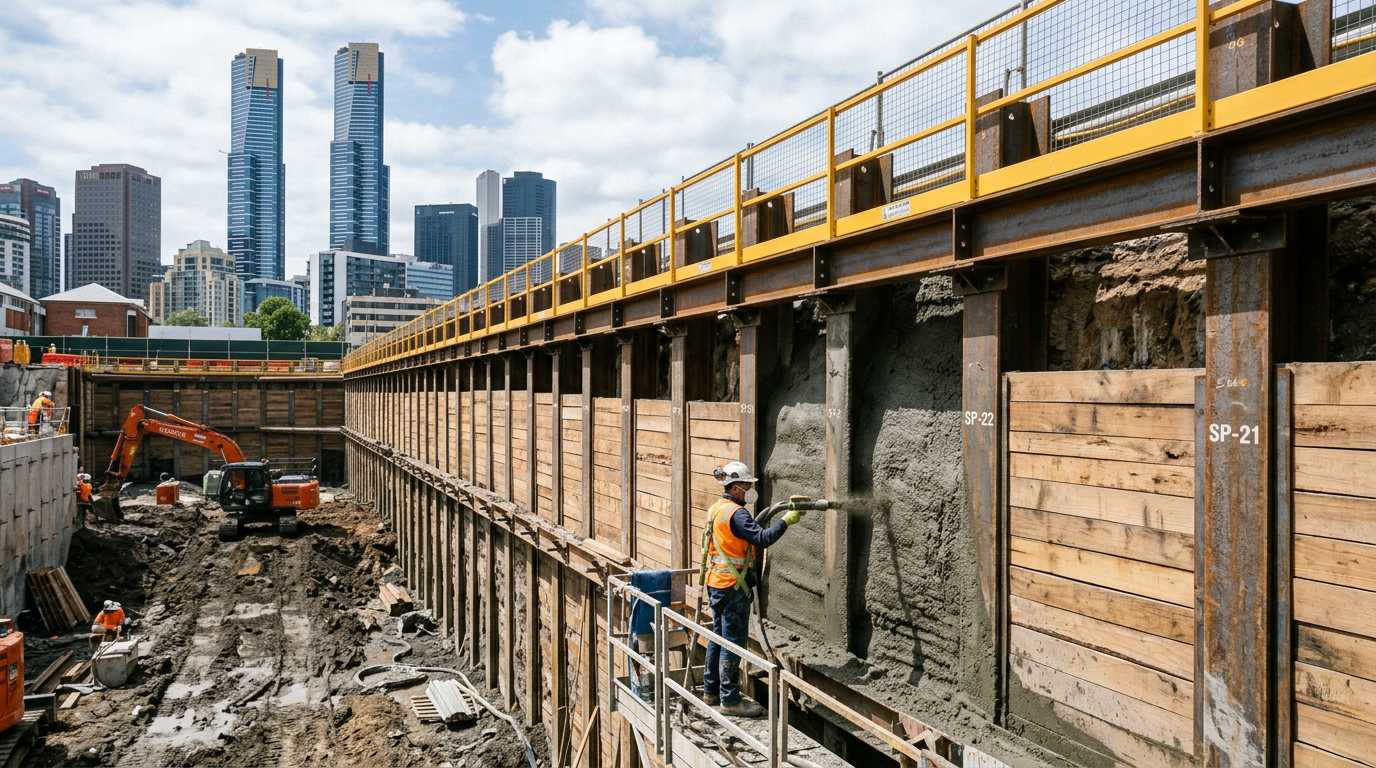
Scope: soldier pile walls, sheet pile walls, secant and contiguous pile walls, soil nails, anchored walls.
What engineers miss most often:
- Load case selection. AS 4678 defines Category 1, 2 and 3 walls — each with different factor-of-safety requirements depending on the consequence of failure. A 3 m basement retention against a neighbour’s house is not a Category 1 wall.
- Drainage design is part of the scope. A retention that works in the dry but fails in a 1-in-100-year rainfall event will fail a proper AS 4678 audit. Wall drainage, weep holes and capping-beam waterproofing must appear on the drawings.
- Monitoring and serviceability. Category 2 and 3 walls usually require instrumentation (inclinometers, survey targets) and trigger levels for movement.
4. Supporting Standards you will cite
These turn up alongside the main three:
- AS 3600 — Concrete structures. Governs bored pier concrete, cages, cover, mix design, load duration factors.
- AS/NZS 4680 — Hot-dip galvanised coatings. The default coating for steel screw piles on a design life of 50 years or more.
- AS/NZS 2327 — Composite steel–concrete members, for composite pile shafts.
- AS 3735 — Concrete for retaining water-bearing structures, relevant for marine cofferdams.
- AS 1289 — Soil testing methods. The full suite referenced throughout AS 2159 Section 4.
- AS 2187.2 — Explosives: storage and use. Less common, but turns up in AS 2159 as the comparison point for vibration monitoring near heritage structures and sensitive equipment.
5. How the Standards actually interact on a project
On a typical tier-1 civil project in Victoria:
- AS 1726 / AS 1289 drive the geotechnical investigation your piling design will stand on.
- AS 2159 is the design framework for foundation piles.
- AS 5100 Part 3 overrides AS 2159 for bridge piers.
- AS 4678 covers basement retention, soldier pile walls and cofferdams.
- AS 3600 covers the concrete in all of the above.
- AS/NZS 4680 covers the galvanising on all external steel.
The compliance pack we deliver on handover names each Standard against each piling element. That level of traceability is what turns a piling subcontract into an auditable lot.
6. The version trap
Contracts often reference a specific edition (AS 2159:2009). If the Standard is updated mid-project, the contract version still governs unless the principal issues a direction. Check the version the contract cites before the first pile goes in — an update between tender and installation is a variation, not a free upgrade.
7. A short reading order for new staff
If you are new to piling in Australia, read in this order:
- AS 2159 Sections 4, 5 and 8 — site investigation, design limit states, testing. This is the piling Standard.
- AS 5100 Part 3 — if you will ever touch bridges.
- AS 4678 Sections 2, 3 and 5 — load cases, design, serviceability for retention.
- AS 3600 Sections 8 and 9 — flexure and development for pile reinforcement.
You will have a working vocabulary within a month.
Need a piling design or compliance review?
Our in-house engineers work to AS 2159, AS 5100, AS 4678 and the full supporting Standards every day. If you want a second-opinion design review, or a design-and-construct bid against your structural loadings, send the geotech and drawings to info@vicpiling.com.au or call 0466 651 881.
References
- Standards Australia, AS 2159:2009 — Piling: Design and Installation (reconfirmed 2018).
- Standards Australia, AS 5100.3:2017 — Bridge Design, Part 3: Foundations and Soil-Supporting Structures.
- Standards Australia, AS 4678:2002 — Earth-Retaining Structures (reconfirmed 2021).
- Standards Australia, AS 3600:2018 — Concrete Structures.
- Standards Australia, AS/NZS 4680:2006 — Hot-dip galvanised (zinc) coatings on fabricated ferrous articles.
- Standards Australia, AS 1726:2017 — Geotechnical Site Investigations.
- Standards Australia, AS 1289 — Methods of testing soils for engineering purposes (referenced set).
- Standards Australia, AS/NZS 2327:2017 — Composite Structures.
- Standards Australia, AS 2187.2:2006 — Explosives — Storage and use — Use of explosives.
Article technically reviewed by a chartered civil/geotechnical engineer (CPEng, MIEAust). Always refer to the currently adopted edition cited in your project contract.
VIC PILING is a specialist piling contractor delivering tier-1 civil, energy, rail and commercial foundations across Victoria since 2016. Our principals bring 30+ years of combined design, installation and compliance experience under AS 2159, AS 5100 and AS 4678.