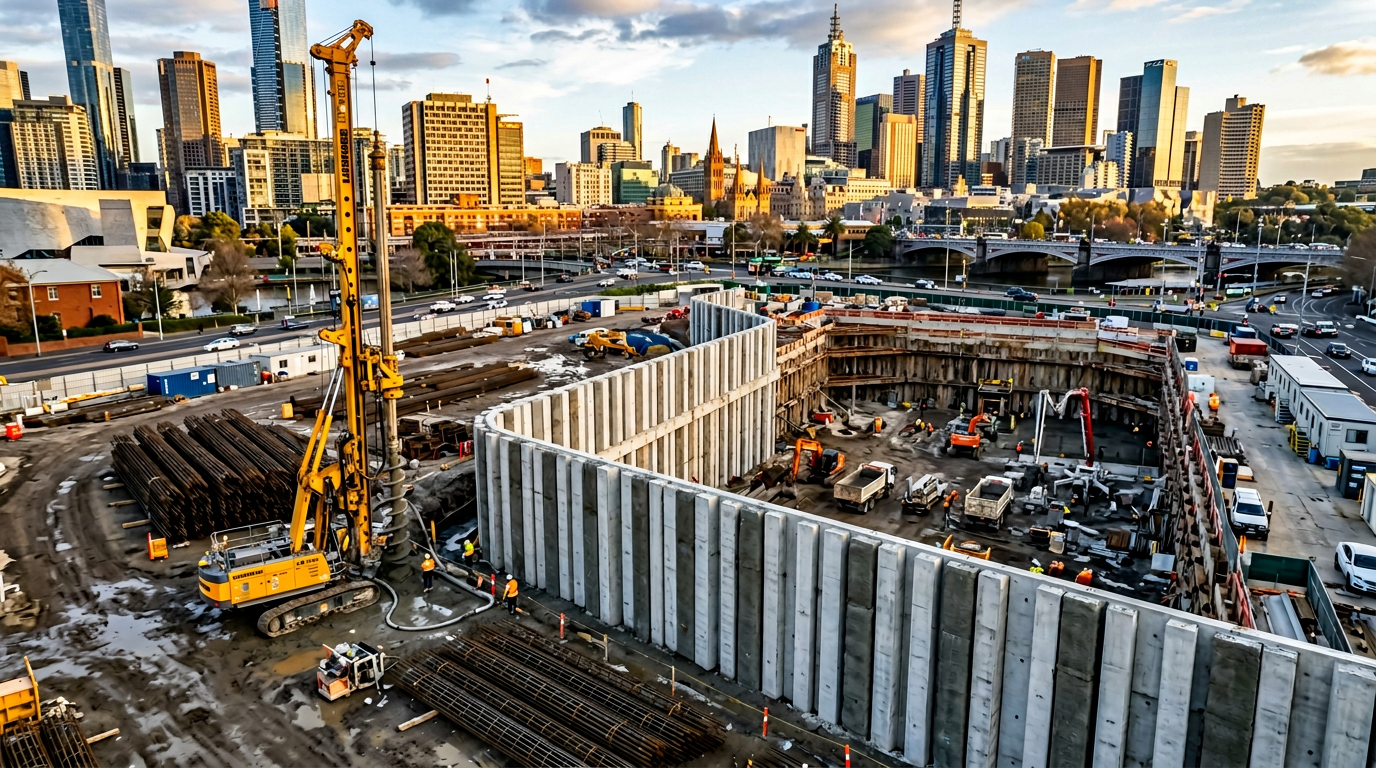
Much of Melbourne’s infill development sits on former industrial land. Fitzroy, Brunswick, Collingwood, Port Melbourne, Coburg, Footscray and large swathes of the western suburbs were working-industry locations for a century. The topsoil is often clean. The fill beneath is often not.
Piling through contaminated fill is a regulated activity with three concurrent workstreams — geotechnical, environmental, and occupational health — that a specialist piling contractor is expected to integrate into a single site plan. Here is how we approach it.
1. The regulatory framework
1.1 Environment Protection Act 2017 (Vic) — the General Environmental Duty (GED)
Under the 2017 Act (effective 2021), everyone conducting an activity that may impact human health or the environment has a statutory General Environmental Duty to minimise risk so far as reasonably practicable. Piling through contaminated ground is squarely within scope.
1.2 The EP Regulations 2021 — priority waste and waste classification
Excavated fill is waste the moment it leaves the site. Classification is governed by IWRG schedule concentrations:
- Clean fill — uncontaminated.
- Category C fill — low-level contamination. Some reuse permitted with a waste-reuse permit.
- Category B — elevated contamination. Licensed landfill.
- Category A — hazardous. Licensed high-risk landfill.
Pile spoil must be tested and classified before disposal. An unclassified load on a truck can draw an EPA infringement of tens of thousands of dollars.
1.3 AS 4482 — Guide to investigation of contaminated sites
The investigation Standard. The environmental assessment that sits alongside the geotech normally references AS 4482.
2. The four contamination profiles you will meet in Melbourne
2.1 Heavy metals from former industrial use
- Where: former smelters, foundries, galvanising plants. Common in Footscray, Port Melbourne, Coburg.
- Contaminants: lead, arsenic, cadmium, chromium, zinc.
- Piling risk: dust from spoil inhalation; leaching if spoil is left exposed to rain.
2.2 Hydrocarbons from former service stations, depots, oil plants
- Where: almost anywhere along a main road corridor. Former Caltex/BP sites; bus depots; oil-storage sites.
- Contaminants: petroleum hydrocarbons, benzene, toluene, ethylbenzene, xylene (BTEX).
- Piling risk: vapour intrusion during drilling; flammable atmosphere in confined spaces; groundwater contamination during excavation.
2.3 Asbestos-contaminated fill
- Where: demolition-fill sites from the 1950s–1980s.
- Contaminants: bonded asbestos cement fragments, loose fibres, insulation.
- Piling risk: airborne fibre release during drilling or auger spoil handling. Regulated under the OHS Regulations 2017 Part 4.4.
2.4 Acid sulfate soils (ASS)
- Where: coastal fill in Port Melbourne, Williamstown, parts of Bay area.
- Contaminants: pyritic soils that oxidise when exposed, producing sulfuric acid.
- Piling risk: groundwater acidification during dewatering; corrosion of steel piles; soil instability once oxidised.
3. Pre-mobilisation — the documents you need
On a contaminated site, the piling contractor should receive or produce:
- Environmental site assessment (ESA) or Detailed Site Investigation (DSI) — identifies contaminants, concentrations and depth profile.
- Remediation Action Plan (RAP) — if remediation is underway.
- Environmental Management Plan (EMP) — conditions for construction.
- Hazardous substances register — what is present, at what concentration, at what depth.
- Safe Work Method Statement (SWMS) — the pile installation method with contamination-specific controls.
- Health-monitoring plan — for workers exposed above action levels.
Turn up to a contaminated site without these and you are leading the compliance failure.
4. Piling methods for contaminated ground
4.1 Driven piles — lowest spoil, lowest exposure
Displacement piles (driven steel or precast concrete) generate essentially no spoil. The pile displaces the soil laterally without bringing it to the surface.
- Best for: asbestos-contaminated fill, light-metal contamination.
- Trade-off: noise and vibration. Not always compatible with inner-urban constraints.
4.2 Steel screw piles — low spoil
Screw piles bring a small amount of surface soil up on the helical plates but otherwise displace the ground.
- Best for: metals, hydrocarbons at depth.
- Watch out for: acid-sulfate soils and aggressive ground — galvanising alone may not be enough; consider sacrificial anodes or sleeve protection.
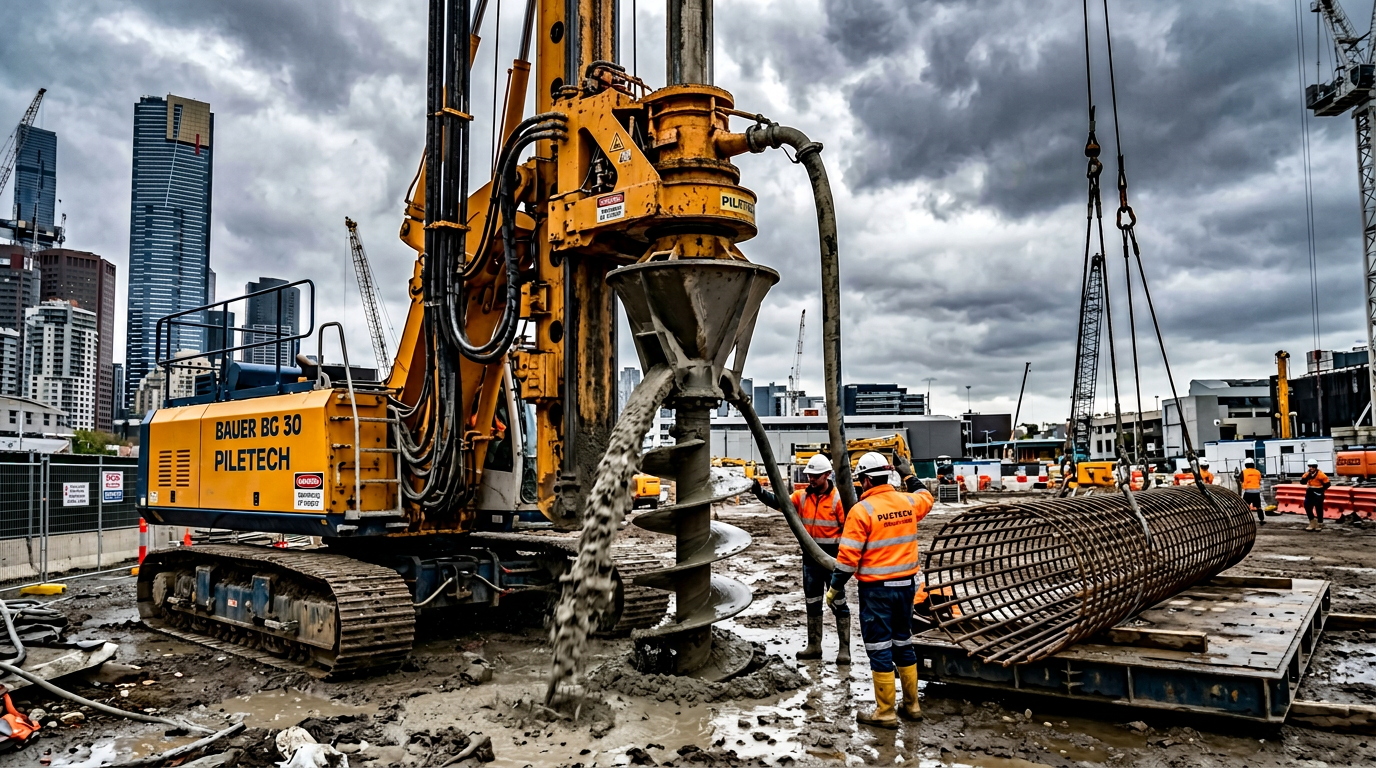
4.3 CFA (continuous flight auger) — controlled spoil
The auger stays in the ground during drilling. Spoil is removed in a single operation as the auger is withdrawn. Spoil management is easier than open-hole boring because it is produced in a controlled way.
- Best for: most contaminated sites. Default method for medium-depth piling in brownfield Melbourne.
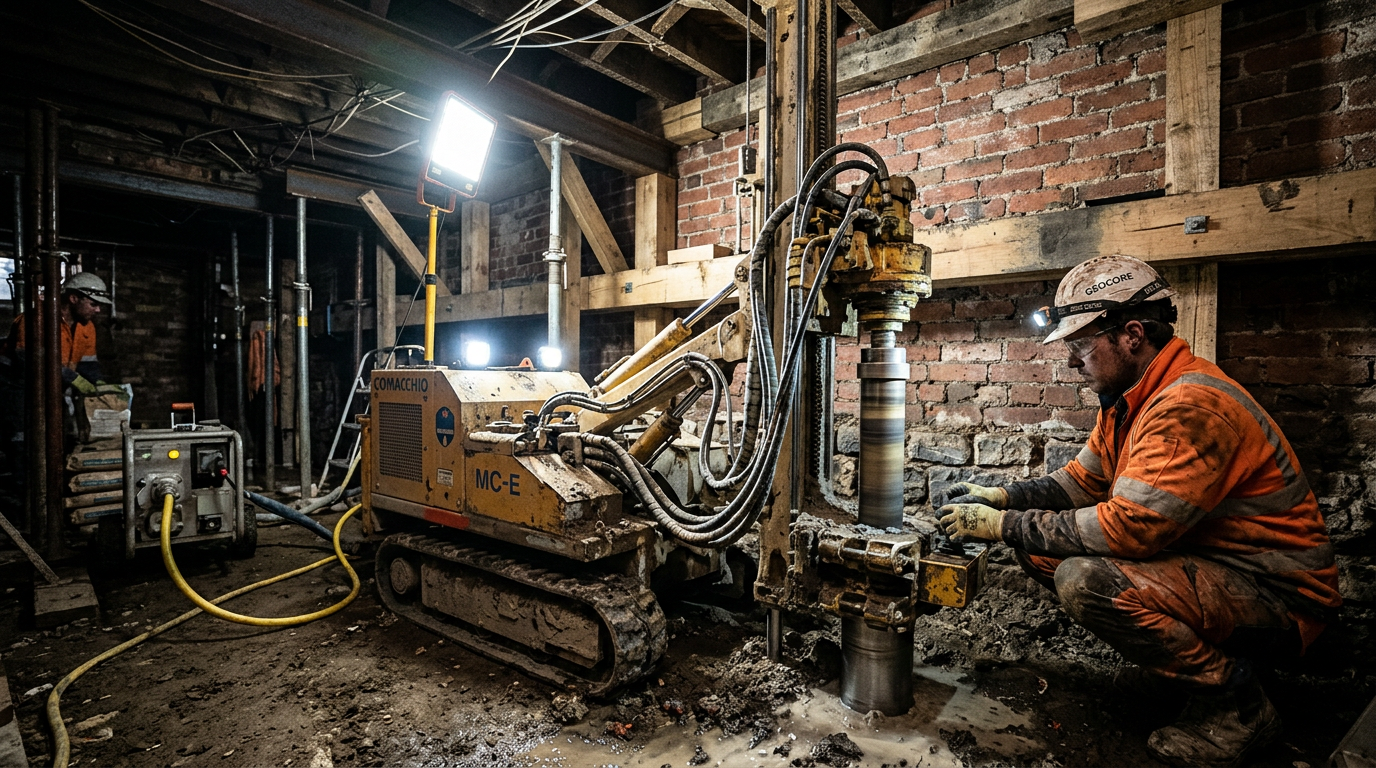
4.4 Rotary bored — most spoil, most control
Rotary bored piers produce the most spoil but give the tightest control over where spoil lands and how it is handled. Clean-out buckets retrieve material in discrete loads rather than continuous cuttings.
- Best for: deeper piles, rock-socketed piers, large-diameter foundations.
- Watch out for: open-hole excavation creates vapour pathways in hydrocarbon ground. Cover and ventilation controls are essential.
5. Spoil management — the five-step protocol
- Segregate by depth. Spoil from clean upper strata is classified differently from spoil below the contamination line. Even if the upper soil is capped, it is often clean and should not be contaminated by mixing.
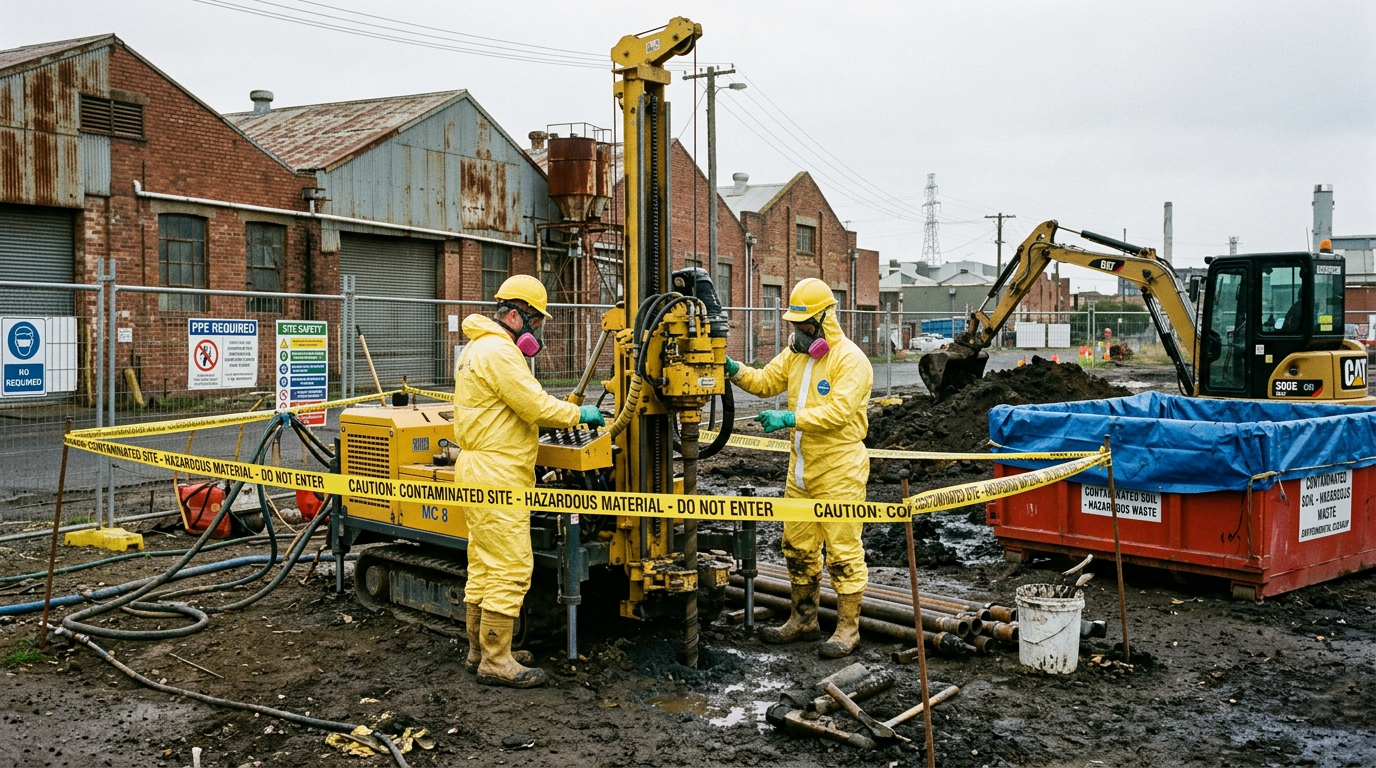
- Bin everything. Skip bins with lockable lids on hardstand. No stockpiling on bare ground unless the EMP explicitly allows it.
- Line the bins for Category B/A spoil — impermeable liner so leachate cannot escape.
- Cover the bins to prevent dust release and rainfall infiltration.
- Sample, classify, dispose. Each bin load sampled per EPA IWRG protocol. Classify before the truck moves. Disposal manifest retained for the project records.
6. Worker health controls
Under OHS Regulations 2017 and the Hazardous Chemicals Code of Practice:
6.1 Respiratory protection
- P2 disposable respirators minimum for dust-generating work.
- Half-face respirator with P3 cartridges for confirmed heavy-metal or asbestos fibre exposure.
- Full-face respirator with air supply for hydrocarbon vapour in confined spaces.
6.2 Protective clothing
- Disposable Tyvek coveralls over high-vis for contaminated spoil handling.
- Chemical-resistant gloves.
- Dedicated boots, cleaned in a boot wash on exit.
6.3 Decontamination
- Three-zone setup: contaminated zone, decontamination zone (boot wash, outer-layer removal), clean zone.
- Eye wash and emergency shower on site.
6.4 Health monitoring
Workers exposed to lead, cadmium, benzene or other scheduled substances above action levels require biological monitoring through an occupational physician. Testing frequency is set by WorkSafe Compliance Code.
7. Groundwater controls
If piling intersects groundwater in a contaminated aquifer, dewatering discharge is regulated:
- Discharge to sewer — needs South East Water or equivalent approval; concentration limits apply.
- Discharge to stormwater — usually requires treatment to ANZECC water-quality guidelines.
- Tanker off-site — licensed liquid-waste carrier, licensed receiving facility.
Specify the dewatering strategy before mobilisation. Discovering at week 2 that you cannot discharge the groundwater you are pumping is expensive.
8. The monitoring package
A compliant contaminated-site piling package includes:
- Air quality monitoring at the site boundary (TSP, PM10, speciated contaminants as applicable).
- Personal exposure monitoring on workers.
- Groundwater monitoring at sentinel bores during dewatering.
- Noise and vibration monitoring as normal.
- Daily site inspection record with sign-off by the environmental advisor.
9. Our brownfield-site checklist
On a Melbourne brownfield site, before the first pile goes in:
- Contamination profile confirmed by ESA/DSI.
- Method selection (driven / CFA / rotary) tied to contamination type and depth.
- Spoil management plan with classification protocol.
- Worker PPE and health-monitoring plan.
- Groundwater discharge strategy.
- Air and vibration monitoring specification.
- Decon zone established.
- Emergency response plan aligned with the EMP.
That is what converts a piling subcontract on contaminated land into a compliant, audit-ready deliverable.
Piling on a Melbourne brownfield site? Send the ESA and drawings to info@vicpiling.com.au or call 0466 651 881.
References
- Environment Protection Authority Victoria, Industrial Waste Resource Guidelines (IWRG 621) and IWRG 702 — Soil Sampling.
- National Environment Protection (Assessment of Site Contamination) Measure (NEPM) 1999, amended 2013.
- Standards Australia, AS 4482.1:2005 — Guide to the investigation and sampling of sites with potentially contaminated soil.
- Standards Australia, AS 1726:2017 — Geotechnical Site Investigations.
- Standards Australia, AS 2159:2009 — Piling: Design and Installation.
- CRC CARE, Technical Report No. 26 — Risk-based assessment of groundwater contamination, 2013.
Article technically reviewed by a chartered civil/geotechnical engineer (CPEng, MIEAust).
VIC PILING is a specialist piling contractor delivering tier-1 civil, energy, rail and commercial foundations across Victoria since 2016. Our principals bring 30+ years of combined design, installation and compliance experience under AS 2159, AS 5100 and AS 4678.