Every Melbourne basement designer eventually faces the same decision: bored pile wall, secant wall, or contiguous wall? The plan view is nearly identical — a line of close-spaced cylindrical piles along the perimeter — but the three systems behave very differently once the excavator drops below the water table. This guide walks through the decision drivers that actually matter, in the order they usually govern.
The three systems in one paragraph each
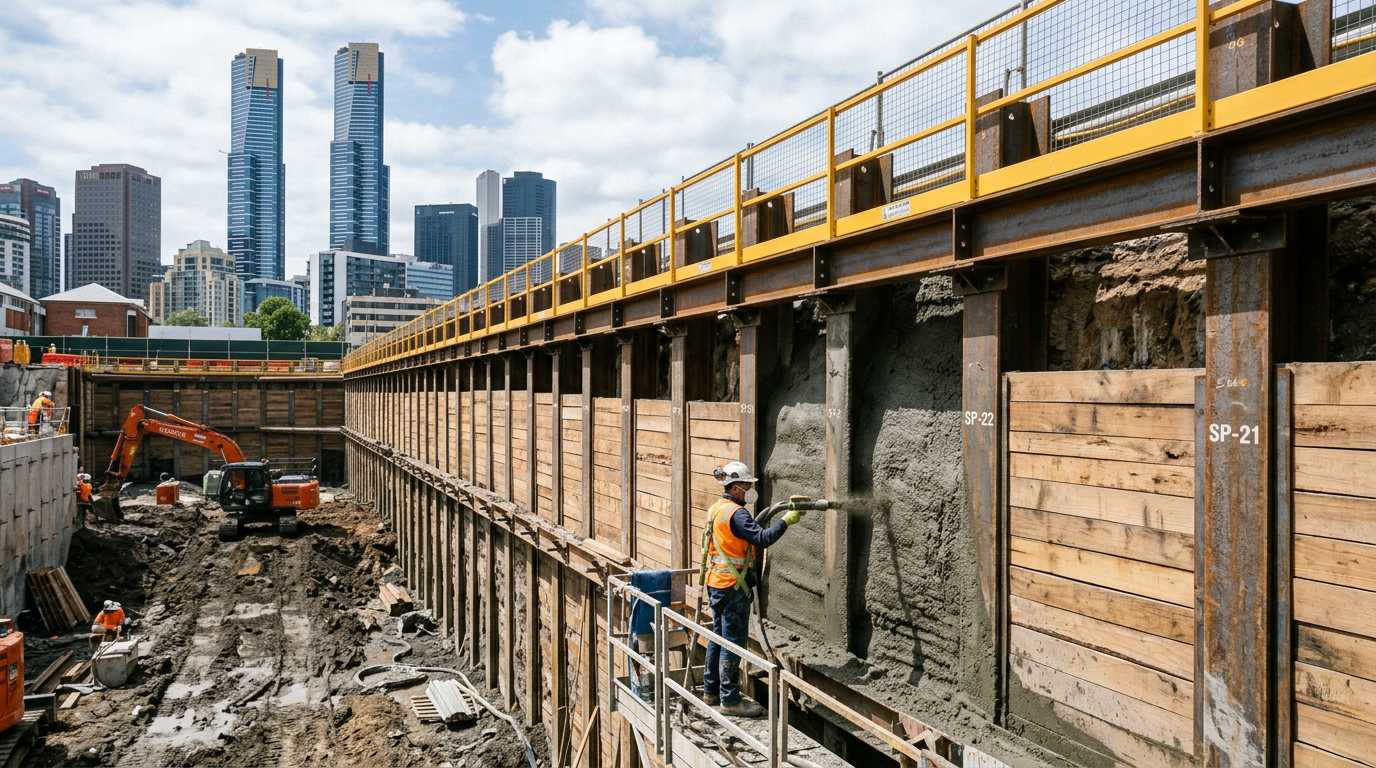
Contiguous (bored) pile wall. A line of reinforced concrete bored piers spaced with a clear gap of 75–200 mm between adjacent piles. Cheapest of the three. Does not hold water. Suited to dry cohesive ground above the water table. The gap is typically shotcreted from inside after excavation.
Tangent pile wall. Adjacent piles installed so their surfaces just touch — no overlap. Marginally more water-resistant than contiguous but still not a water-retaining wall. In practice this system is now rare in Australia because the tolerance band (±25 mm verticality at depth) rarely delivers true tangency — you end up with either a small gap (contiguous) or a small overlap (badly-detailed secant).
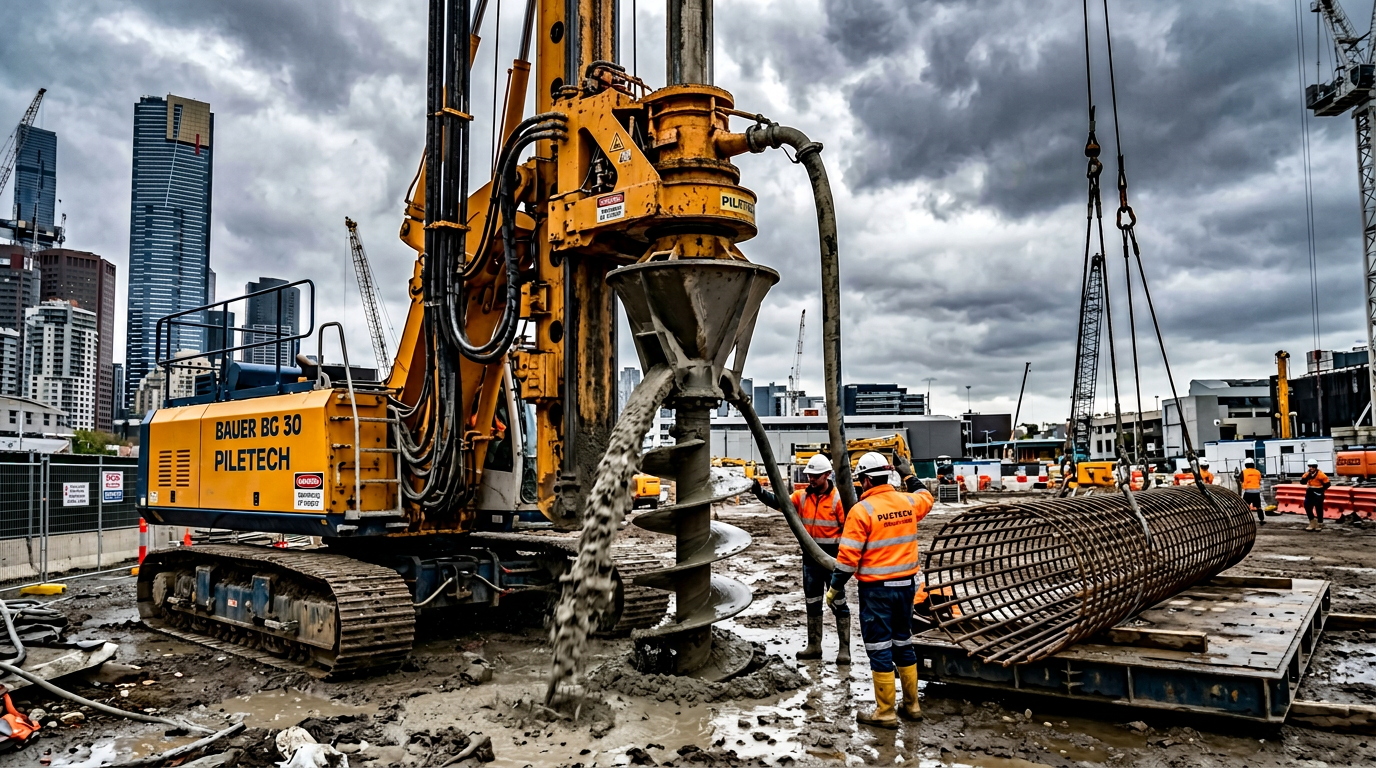
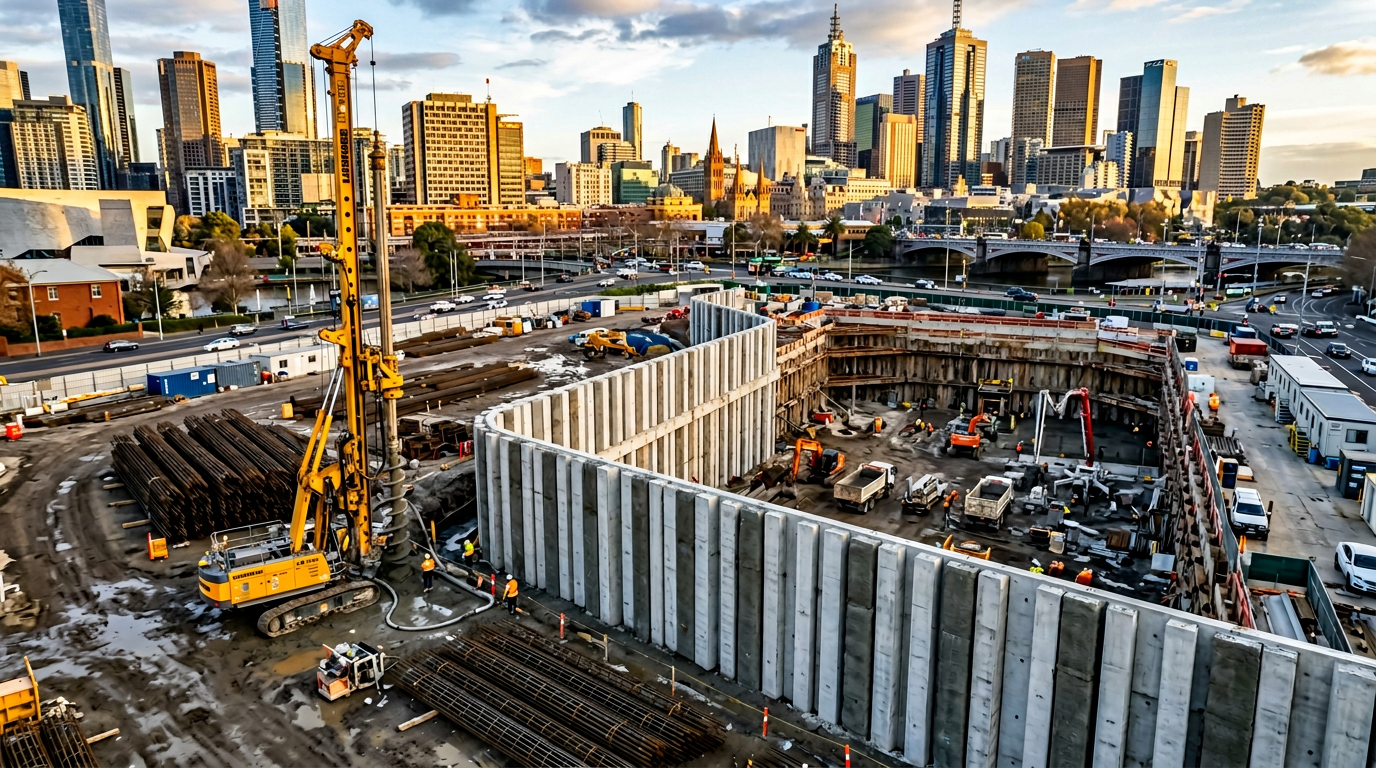
Secant pile wall. Alternating primary (unreinforced or lightly reinforced, lower strength) and secondary (reinforced, full strength) piles with an overlap of typically 150–250 mm. Primaries are installed first, then the secondaries cut into the primaries on both sides. The overlap zone forms a continuous water-retaining wall.
Decision driver 1 — Is the water table above the pour level?
This is the dominant question. If the water table is above basement slab level at any point in the year, contiguous walls are almost always the wrong answer. Running water lifts fines through the inter-pile gaps, undermines adjacent infrastructure, and forces a secondary waterproofing system (sprayed concrete over a drainage membrane) that costs more than the water-retaining wall it was meant to replace.
On most of the Melbourne CBD, St Kilda Road, Docklands and South Yarra, the groundwater table sits 3–7 m below natural surface. Any basement deeper than one level has to be treated as a water-retaining structure unless a dewatering system and EPA permit are in place for the duration of works.
Rule of thumb:
- Basement floor above groundwater → contiguous is viable.
- Basement floor below groundwater → secant (or sheet piles, or a diaphragm wall) is required.
Decision driver 2 — Wall height and lateral stiffness
Contiguous piles act as independent cantilevers until the capping beam ties them together at the top. Between the capping beam and any propping or anchor level, each pile is a standalone bending element. The wall’s effective stiffness is roughly the sum of the individual piles.
Secant piles, by contrast, behave as a continuous wall — the overlap zone transmits shear between primaries and secondaries. The wall acts as a single curved slab for the purposes of lateral analysis. For deep basements (>8 m retained height) the reduction in wall deflection is material — often 20–40% less than a contiguous wall of the same pile diameter.
For walls shorter than ~4 m retained height with one level of props, contiguous is usually fine. For walls over 6–7 m retained, or for multi-level basements, secant starts to pay for itself in reduced deflection, reduced cracking of adjacent structures, and tighter stiffness compatibility with any permanent works.
Decision driver 3 — Adjacent structures and vibration
Melbourne basements are increasingly installed against heritage masonry, rail corridors, or instrumented neighbouring towers. On those sites, deflection limits become the governing design criterion, not pile strength.
- BS 5228 / DIN 4150 lateral-movement limits for Category I masonry (typical inner-Melbourne terrace) are 3–5 mm at the wall face.
- Tight stiffness → less movement. Secant walls win.
- Vibration during install is broadly equivalent for all three systems (all are rotary-bored, CFA or cased rotary).
See our article on vibration limits and heritage buildings for the full set of limits.
Decision driver 4 — Cost and program
Per square metre of retained face, the typical 2026 Melbourne pricing hierarchy is:
- Contiguous (600 mm piles, 10 m deep): baseline.
- Tangent: +15–25% vs contiguous, but rarely specified.
- Secant (600 mm primaries + 750 mm secondaries, 10 m deep, 180 mm overlap): +50–90% vs contiguous.
- Diaphragm wall (800–1200 mm thick panels): +150–250% vs contiguous; economic only on very deep basements (>15 m).
Program-wise, a secant wall installs at about 60–70% the rate of a contiguous wall of the same dimensions, because each secondary pile requires the primary on either side to have cured to a specific cutting strength (typically 1–2 MPa, reached in 8–24 hours).
Design detailing — what the structural drawing must cover
A complete secant or contiguous wall drawing package includes:
- Pile setting-out with tolerance limits at the top of each pile (±25 mm in plan, typical) AND the verticality tolerance at depth (1:200 minimum for secants to achieve 180 mm overlap at 10 m depth).
- Capping beam — reinforced concrete beam tying all pile heads together, designed for bending between props and the overall lateral load.
- Prop / anchor levels — ground anchors (typical) or raker props. Each level governs one “storey” of the wall’s bending diagram.
- Drainage system — for contiguous walls, a cavity drainage and sump system behind the internal lining. For secant walls, purely redundancy drainage if any leaks develop.
- Waler or capping tie-in to slabs for permanent-works design.
- Construction joints — especially the interface between the basement slab and the wall, and the wall-to-podium slab connection.
- Monitoring plan — surface settlement points, inclinometers in the wall, tilt meters on adjacent structures. Not optional for tier-1 jobs.
Common design pitfalls
These are the issues that recur on Melbourne basement jobs:
- Specifying a contiguous wall “with shotcrete” below the water table. This never works long term. Either go secant, or dewater and document the EPA approval, or switch to sheet piles (see our sheet piling and cofferdam article).
- Ignoring verticality tolerance. At 12 m depth, a 1:200 out-of-plumb means 60 mm at the toe. Two adjacent piles tilting in opposite directions have a 120 mm relative offset — enough to destroy a 180 mm specified overlap.
- Primary concrete strength too high. Primaries are often specified at 15–20 MPa so the secondary pile auger can cut them cleanly. Standard-mix 40 MPa primaries can jam the secondary rig.
- Capping beam as an afterthought. The capping beam is the single most structurally-critical element in the whole wall. Reinforcement detailing into every pile, continuity laps, and thermal-expansion joints all need engineer input.
- No monitoring plan. Surface settlement and inclinometer readings are what prove the wall is performing. They also settle arguments with neighbours quickly.
When sheet piling or diaphragm wall is the answer instead
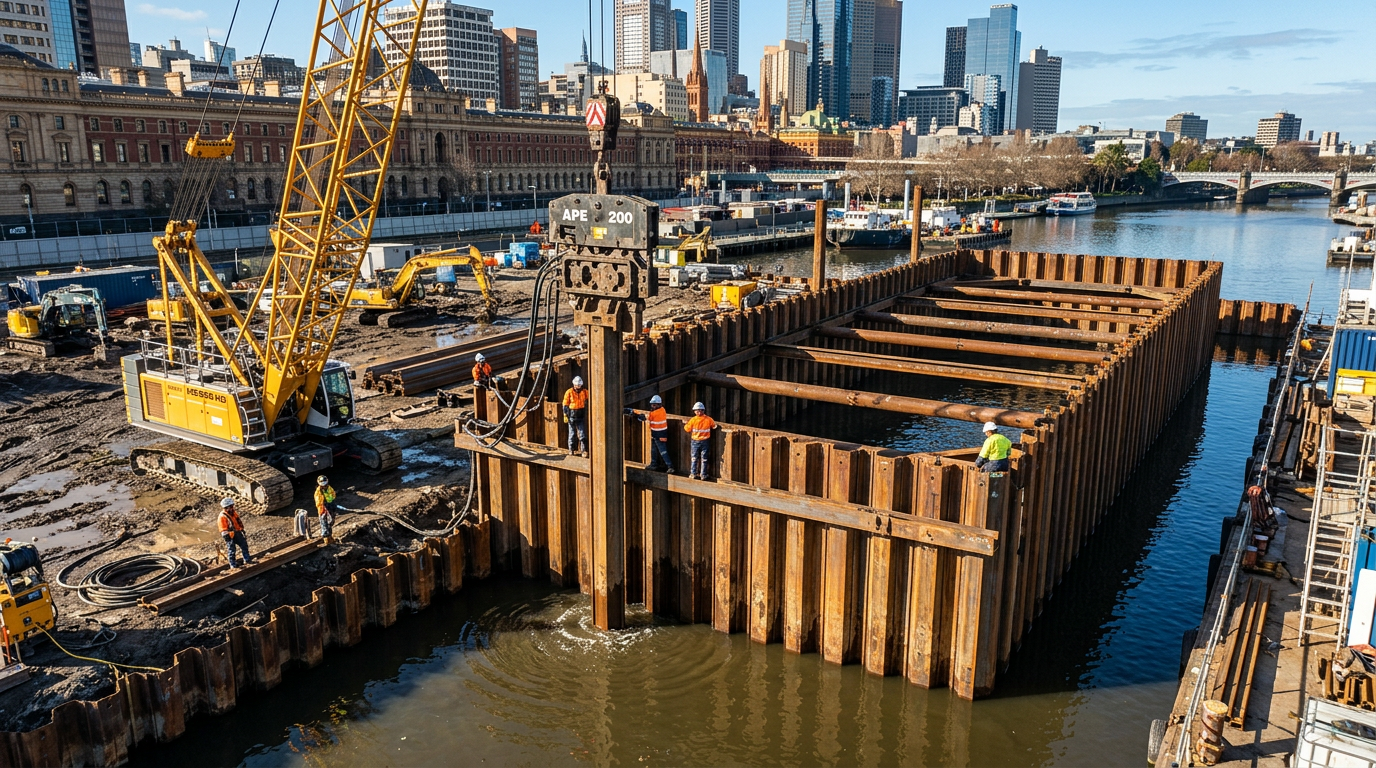
- Sheet piles — viable for retained heights up to ~6 m and where vibration or noise is acceptable. Much faster and cheaper than secant. Best for short-duration construction cofferdams rather than permanent basement walls.
- Diaphragm walls — the right answer for very deep basements (>15 m retained), or where extreme stiffness is needed (monumental buildings, very close to rail), or where permanent works require a single structural wall acting as both retention and the perimeter basement wall.
References
- Standards Australia, AS 2159:2009 Piling — Design and Installation.
- Institution of Civil Engineers (UK), Specification for Piling and Embedded Retaining Walls (SPERWall), 3rd ed., 2017.
- Gaba A.R., Simpson B., Powrie W., Beadman D.R., Embedded Retaining Walls: Guidance for Economic Design, CIRIA C580, 2003.
- BS 5228-2:2009, Code of practice for noise and vibration control on construction and open sites — Vibration.
VIC PILING is a specialist piling contractor delivering tier-1 civil, energy, rail and commercial foundations across Victoria since 2016. Our principals bring 30+ years of combined design, installation and compliance experience under AS 2159, AS 5100 and AS 4678.