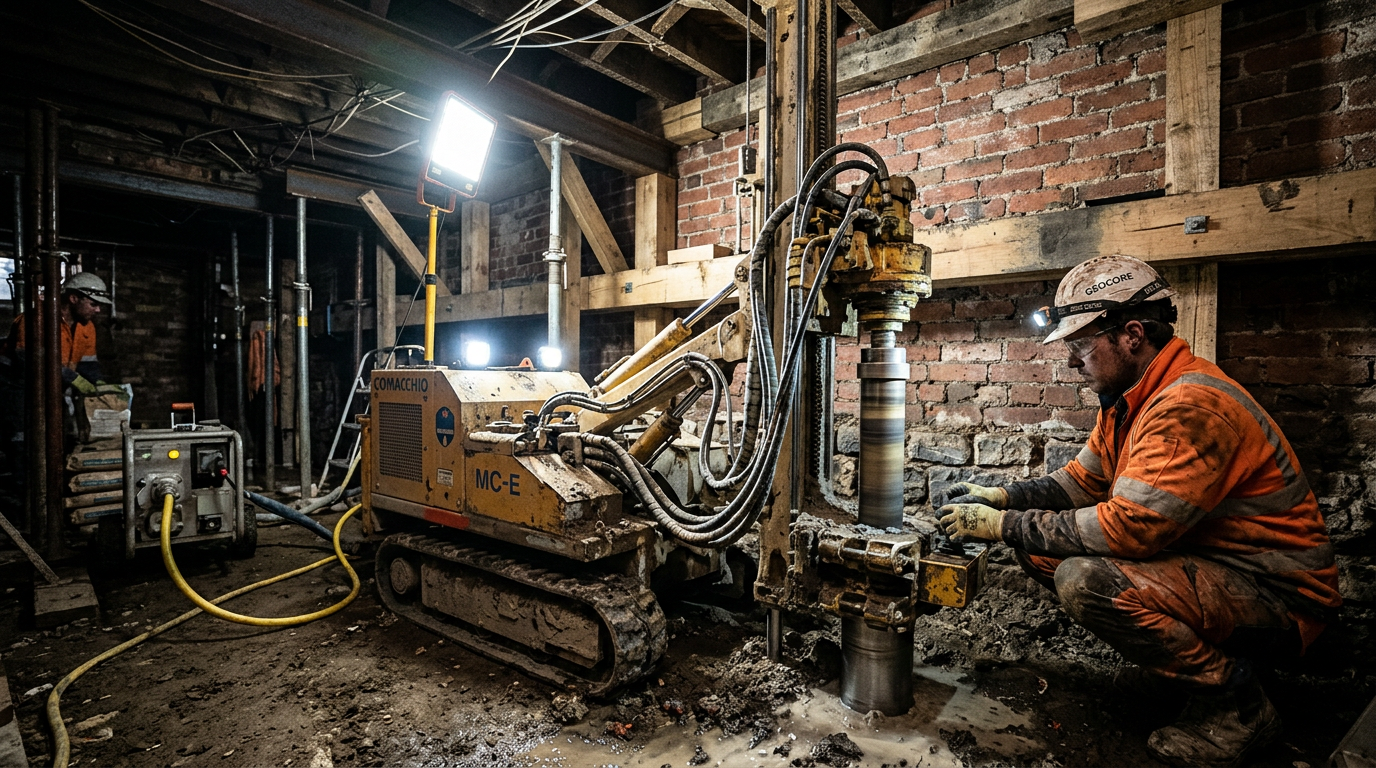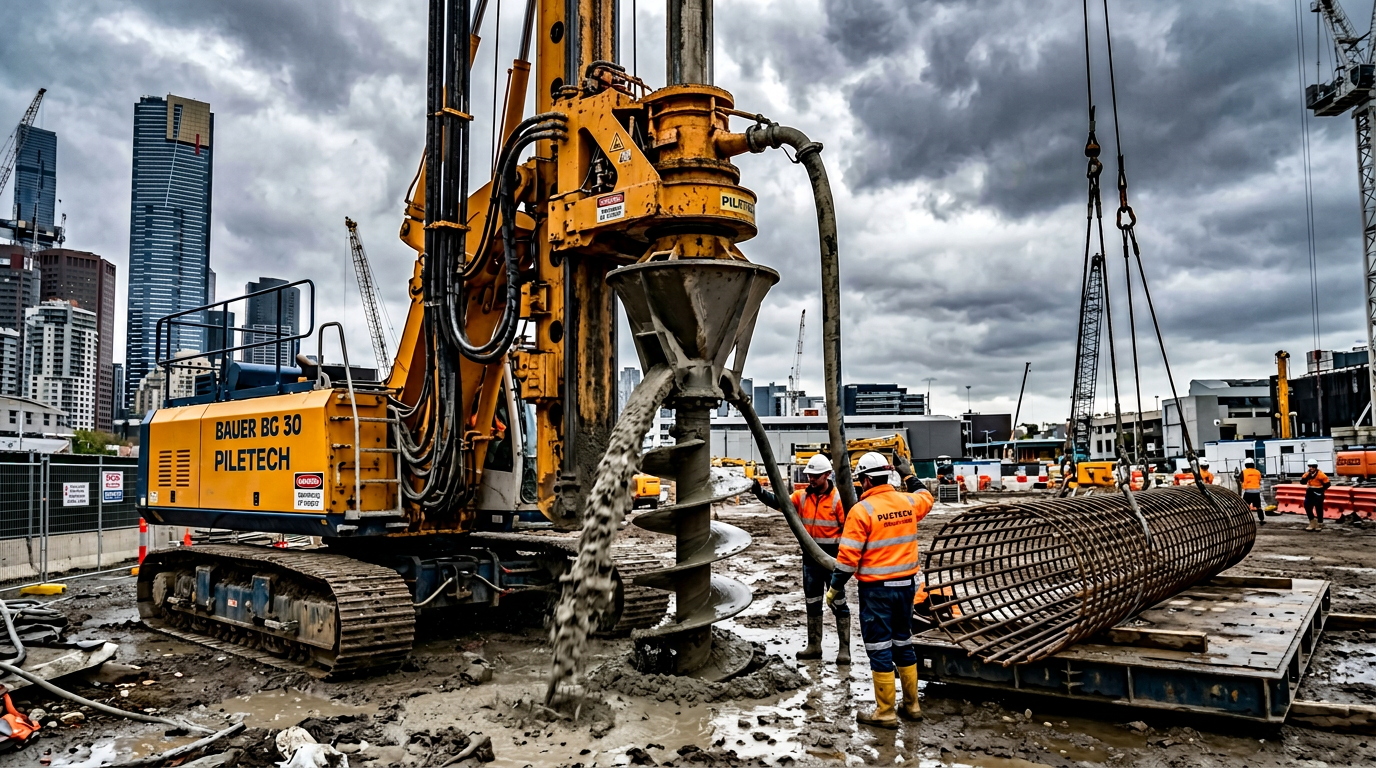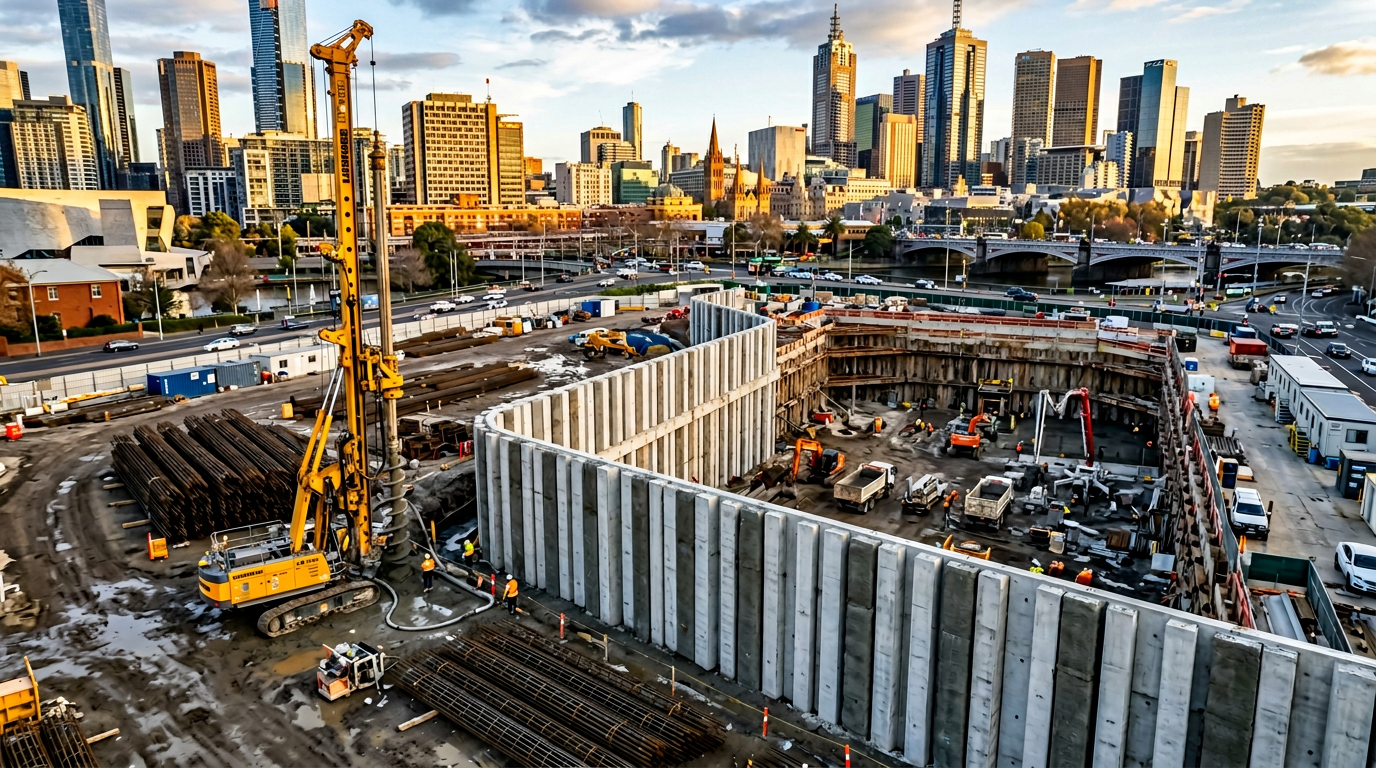
Piling in inner Melbourne means working within a few metres of heritage buildings. A basement in Collins Street, a foundation repair in South Yarra, a road-widening next to a Carlton terrace — all the same problem. The buildings are fragile, the owners are alert, and the vibration limits are tight. Exceed them once and the job stops.
This is the working engineer’s view of how to get vibration-sensitive piling work approved, installed and signed off.
1. The Standards that apply
Three documents govern the vibration conversation in Victoria:
1.1 DIN 4150-3 (German Standard, internationally adopted)
Gives peak particle velocity (PPV) limits for different structure types and vibration frequencies. This is the Standard most heritage authorities cite.
1.2 AS 2187.2 (Explosives — the Australian reference)
Although it is written for blasting, its PPV limits are the closest Australian equivalent. Often cited alongside DIN 4150-3.
1.3 BS 7385-2 (British Standard)
Cited for buildings of historic or architectural value. Provides more conservative limits than DIN for heritage structures.
2. Typical vibration limits
Peak particle velocity (PPV), measured at the foundation of the nearest sensitive structure, is the governing parameter. Typical limits:
| Structure class | DIN 4150-3 PPV limit | AS 2187.2 | BS 7385-2 |
|---|---|---|---|
| Industrial / robust | 20–50 mm/s | 25 mm/s | — |
| Residential (normal) | 5–20 mm/s | 10 mm/s | 20 mm/s |
| Heritage / sensitive | 3 mm/s | 5 mm/s | 7.5 mm/s |
| Ancient or very fragile | ≤ 2 mm/s | — | — |
Heritage Victoria typically nominates 3 mm/s at the nearest heritage structure as a trigger level, with a 50% investigation level (i.e. 1.5 mm/s) as an amber alert.
3. What a vibrator or hammer actually produces
Approximate source vibration for common piling methods, measured 10 m from the source on competent ground:
| Method | Typical PPV at 10 m |
|---|---|
| Impact hammer (diesel) on steel pile | 10–25 mm/s |
| Vibratory hammer on steel sheet pile | 5–15 mm/s |
| Hydraulic press-in (silent piler) | 0.3–1.0 mm/s |
| Rotary bored piling rig | 0.5–2.0 mm/s |
| CFA piling rig | 0.3–1.5 mm/s |
| Heavy tracked plant movement | 1–3 mm/s |
A 3 mm/s limit at 10 m rules out impact and vibratory driving. It leaves rotary bored piling, CFA, and press-in sheet-pile installation as the compliant options.
4. Attenuation with distance — the working rule
Ground-borne vibration attenuates roughly according to:
PPV(r) = PPV(1m) × (1/r)^nwhere n is the attenuation exponent (1.0 for body waves, up to 1.5 in soft soils, as low as 0.5 in very stiff rock).
A practical rule for Melbourne: assume n = 1.0 until you measure otherwise. Then for every doubling of distance, PPV halves.
If your monitoring shows 4 mm/s at 5 m, expect 2 mm/s at 10 m, 1 mm/s at 20 m.
5. The approval documents a heritage authority expects
Five documents make up a compliant piling-near-heritage submission:
- Vibration impact assessment — estimated PPV at each sensitive receiver, source-by-source, based on the proposed methods.
- Method statement — specific installation methods for each pile (press-in, bored, CFA, etc.) with vibration-class justification.
- Condition survey report — pre-works photographic and dilapidation survey of every heritage structure within the zone of influence (typically 50 m radius).
- Monitoring plan — sensor locations, trigger levels, escalation procedure, reporting frequency.
- Contingency plan — what happens if a trigger is exceeded. Who stops work, who is notified, what investigation occurs before resumption.
Heritage Victoria and local council heritage advisors read all five. A submission missing one of them gets returned.
6. Methods that stay inside the limits
6.1 Hydraulic press-in (silent piler)
Effectively zero vibration. Used routinely next to heritage buildings, hospitals, and sensitive equipment. The pile is hydraulically pushed into the ground using reaction against already-installed piles. Slow, expensive per metre, but the only option where noise and vibration matter most.
6.2 Rotary bored piling
Well below heritage trigger levels for standard operations. The rig itself transmits some vibration through tracked movement — site rig pads matter.
6.3 CFA (continuous flight auger)
Very low vibration. The auger stays in the ground while concrete is pumped, so there is no hammer impact at any stage.
6.4 Down-hole hammer (for rock sockets)
Produces higher-frequency vibration than impact driving. Usually acceptable under DIN 4150-3 because the limits rise above 50 Hz — but verify by measurement.
7. Methods that need careful design
7.1 Vibratory sheet pile driving
Can be made compliant by starting the hammer at a high frequency (≥ 30 Hz) where the sensitive-structure limits are higher, and by staged driving with rest periods between piles.
7.2 Screw pile installation
Generally low vibration, but the reaction force transmitted through the tracked carrier across soft Melbourne clay can generate noticeable ground movement. Monitor the carrier track rather than the pile itself.
8. Monitoring — how to do it properly
8.1 Sensor selection
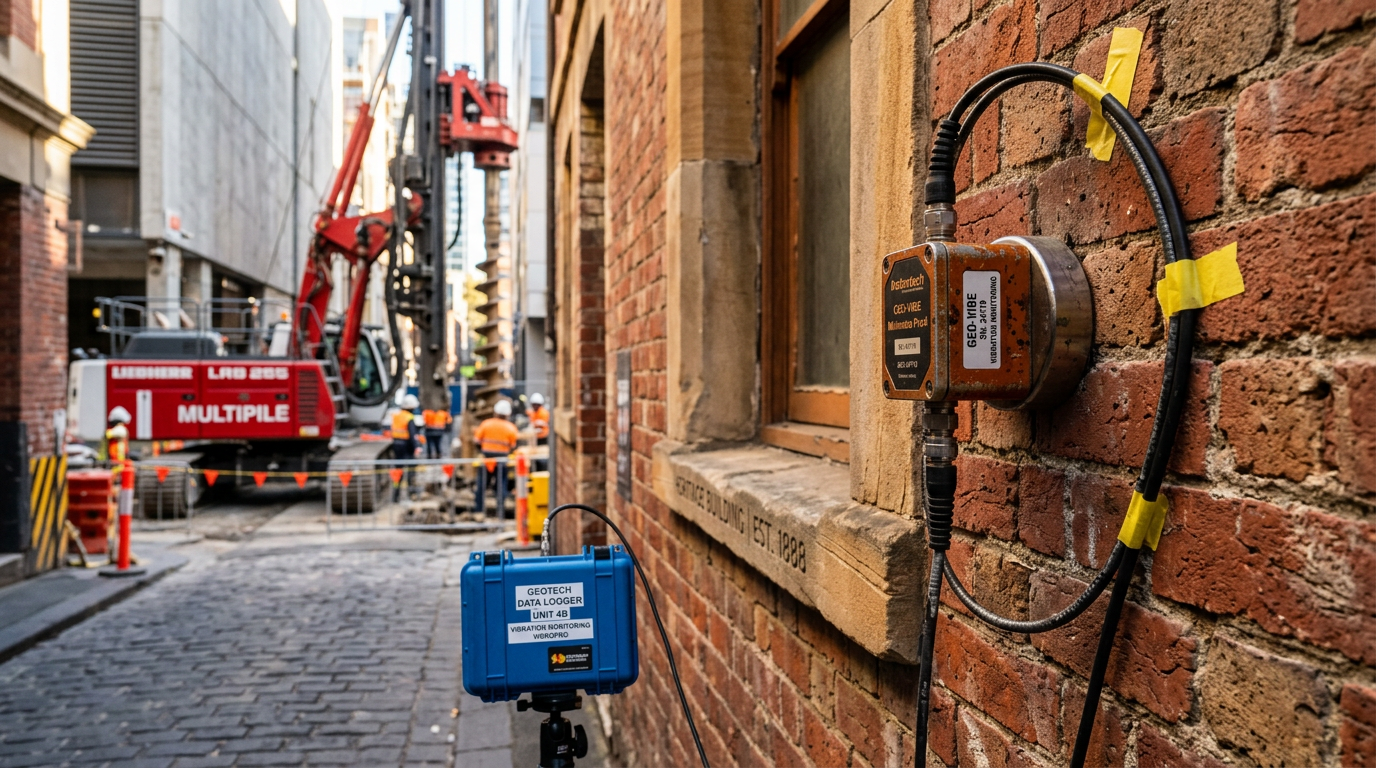
Triaxial geophones, calibrated, recording continuously. Peak particle velocity reported in three orthogonal axes with the vector resultant. Cheap single-axis monitors are not acceptable for Heritage Victoria submissions.
8.2 Sensor placement
Attach to the foundation of the sensitive structure (not the roof, not the wall coping). Typically coupled to the masonry at ground-floor level using steel-plate magnetic mount or bolt-down bracket.
8.3 Data handling
Real-time upload to a cloud platform with SMS alerts to the site supervisor at amber and red thresholds. Daily reports; a weekly summary signed by the vibration engineer.
8.4 Calibration and records
Sensors calibrated annually by an accredited lab. Calibration certificates included in the final compliance pack.
9. When you do exceed a trigger
Two things happen:
- Work stops at the affected source.
- An investigation runs before work resumes. That investigation covers:
- Verification of the monitoring data.
- Inspection of the affected structure by a qualified structural engineer.
- Review of the installation method.
- Revised method statement and, if necessary, revised monitoring arrangements.
A single exceedance is a process event — handled correctly it causes a shift of delay, not a week. Handled badly (ignoring the trigger, not notifying) it causes a site shutdown and, frequently, an enforcement notice.
10. The realistic-pricing reality
Working adjacent to heritage structures costs more. The reason is obvious:
- Press-in installation is slower per metre than vibratory.
- Rotary bored piling with a down-hole inspection costs more than CFA.
- Continuous monitoring, condition surveys and reporting costs programme time.
A piling sub who quotes the same rate for an inner-Melbourne heritage site as for a greenfield warehouse is either unfamiliar with the constraints or intends to request variations later. Either way, it is a risk.
11. Our approach
On inner-Melbourne heritage-adjacent projects we default to:
- Hydraulic press-in for sheet piles.
- Rotary bored or CFA for foundation piles.
- Full pre-condition survey within a 50 m radius.
- Real-time vibration monitoring at every sensitive receiver.
- Daily reports to the principal and the heritage advisor.
- A single named vibration engineer accountable for the data.
That is the package that gets piling approved, installed and signed off without incident.
Piling next to a heritage structure on your next job? Send the brief to info@vicpiling.com.au or call 0466 651 881.
References
- DIN 4150-3:2016-12, Vibrations in buildings — Part 3: Effects on structures.
- BS 7385-2:1993, Evaluation and measurement for vibration in buildings — Part 2: Guide to damage levels from groundborne vibration.
- BS 5228-2:2009+A1:2014, Code of practice for noise and vibration control on construction and open sites — Part 2: Vibration.
- Standards Australia, AS 2187.2:2006 — Explosives — Storage and use — Use of explosives (vibration limits referenced in piling near heritage).
- Heritage Victoria, Works to historic buildings — general guidelines (statutory overlay requirements).
- Athanasopoulos, G. A. & Pelekis, P. C., “Ground vibrations from sheetpile driving in urban environment”, Soil Dynamics and Earthquake Engineering, 19(5), 2000.
Article technically reviewed by a chartered civil/geotechnical engineer (CPEng, MIEAust) with heritage-adjacent piling experience.
VIC PILING is a specialist piling contractor delivering tier-1 civil, energy, rail and commercial foundations across Victoria since 2016. Our principals bring 30+ years of combined design, installation and compliance experience under AS 2159, AS 5100 and AS 4678.