Every head contractor’s estimator wants the same thing on day one of the tender: a credible per-metre rate for the piling. The piling subcontractors want the same thing on day one of the tender: enough information to quote without padding. The two sides rarely meet.
This article is an honest breakdown of what piling actually costs in Victoria in 2026 — what’s in the rate, what’s not, and where the surprises live. The numbers are our order-of-magnitude estimates for typical tier-1 civil and commercial tenders. They are indicative, not a quote.
The headline numbers — Victoria, 2026
| Pile type | Typical diameter | Depth range | Rate per lineal metre (piling only) | Typical minimum mobilisation |
|---|---|---|---|---|
| Bored pier, dry | 450 mm | 8–15 m | $350–480 | $8k |
| Bored pier, dry | 600 mm | 10–20 m | $520–720 | $10k |
| Bored pier, dry | 900 mm | 15–30 m | $950–1,450 | $15k |
| Bored pier, cased | 900 mm | 20–35 m | $1,350–1,850 | $25k |
| Bored pier w/ rock socket | 900 mm | 15–25 m + 3 m socket | +$400–900/m socket | — |
| CFA | 450 mm | 10–18 m | $340–440 | $12k |
| CFA | 600 mm | 15–22 m | $520–650 | $15k |
| Screw pile | 324 mm | 6–15 m | $220–320 | $6k |
| Screw pile | 610 mm | 10–20 m | $520–720 | $10k |
| Screw pile | 1050 mm | 15–30 m | $1,450–2,400 | $18k |
| Sheet piling (U-type) | — | 6–10 m | $410–580 per m² wall | $15k |
| Soldier pile wall | 450 mm piles at 2 m c/c | 8–12 m | $950–1,350 per m wall | $20k |
| Micropile (Type A) | 200 mm | 8–15 m | $620–850 | $12k |
These are “piling only” rates. They do not include reinforcement supply, concrete supply, test piling, monitoring, civil works, spoil removal, or any non-piling scope. Those sit below.
What’s in the rate
The per-metre rate above typically includes:
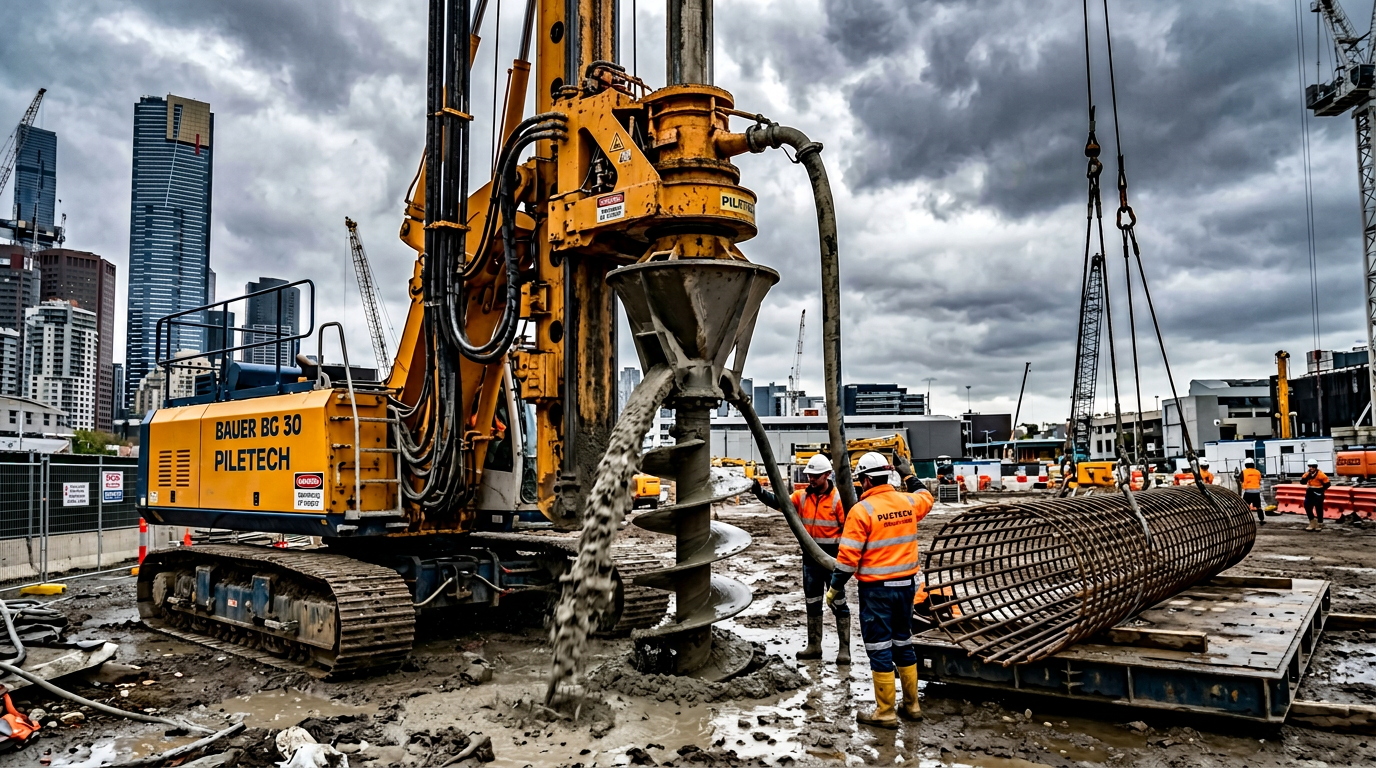
- Rig on site, operator, supporting crew. Usually a 3- or 4-person crew at Victorian union rates (EBA + overheads). This is the single biggest cost driver.
- Consumables — drilling fluids, cutting teeth, mud-mixing additives for cased-rotary jobs.
- Fuel and utilities — diesel for the rig, water supply, spoil removal to standard (non-contaminated) landfill.
- Basic site setup — perimeter fence, amenities allowance, first-aid, site inductions.
- Normal QA paperwork — instrumented rig printouts, concrete delivery dockets, basic pile records.
What’s NOT in the rate (the reason quotes come back “higher than we thought”)
This is the list where tender gaps usually live:
- Reinforcement cages — typically $1,750–2,400/tonne delivered in 2026 for N32 bar with minor fabrication. Add 10% for roller spacers and extra ligatures. A 900 mm pile at 20 m with 6 × N32 + R12 spiral runs ~0.5 tonne per pile = $900–1,200.
- Concrete supply — 40 MPa piling mix, small-aggregate, 200 mm slump is ~$290–340/m³ delivered in Melbourne in 2026. A 900 mm × 20 m pile = 12.7 m³, ~$3,800 concrete per pile.
- Temporary casing installation — cased-rotary adds typically $200–350 per lineal metre cased, depending on casing size and retrieve/re-use arrangements.
- Rock socketing — the socket itself is priced at a premium because it eats tooling and time. See the table above. Rock excavation rate is typically 3–6× the soil rate.
- Spoil classification and disposal on contaminated or mixed-waste sites. EPA category 1–3 disposal rates: $180–450/tonne in 2026. On a 900 mm pile at 20 m, spoil is ~25 tonnes. Contaminated spoil can add $4k–11k per pile.
- Dewatering — pump hire, discharge permit, sediment control.
- Load testing — static test: $45k–120k per test for typical pile sizes. Dynamic PDA: $12k–18k per pile tested plus $25k–40k mobilisation. Osterberg cell (O-cell) test: $80k–220k per test. See our pile load testing guide.
- Instrumentation — CSL tubes, strain gauges, thermal integrity probes. Typical: $350–550 per pile for four CSL tubes pre-installed.
- Verification and certification — engineer-signed install records, load-test report, chartered-engineer handover certificate. Typically 1–2% of job total; sometimes a stand-alone line at $8k–15k.
- Mobilisation and demobilisation — rig transport, crew mobilisation. Metropolitan Melbourne: $8–15k each way. Regional Victoria (Ballarat, Bendigo, Geelong): $12–20k. Remote (Gippsland, Mildura): $18–30k.
What drives cost variability
Two projects with the same total pile metres can price 50% apart. The drivers:
1. Piece-count vs total metres
Fixed rig-on-site cost spreads across the metres you drill. 40 piles at 20 m = 800 m: very efficient. 10 piles at 80 m each = also 800 m, but you’ve got a large diameter, deeper rig setup, possibly casing, and significantly more mobilisation per pile. Second case typically prices 30–50% higher per metre.
2. Ground quality
Dry cohesive ground → good rate. Running sand below water table → requires casing → +30–60%. Hard rock socketing → +100–200% on the socket length.
3. Access and site conditions
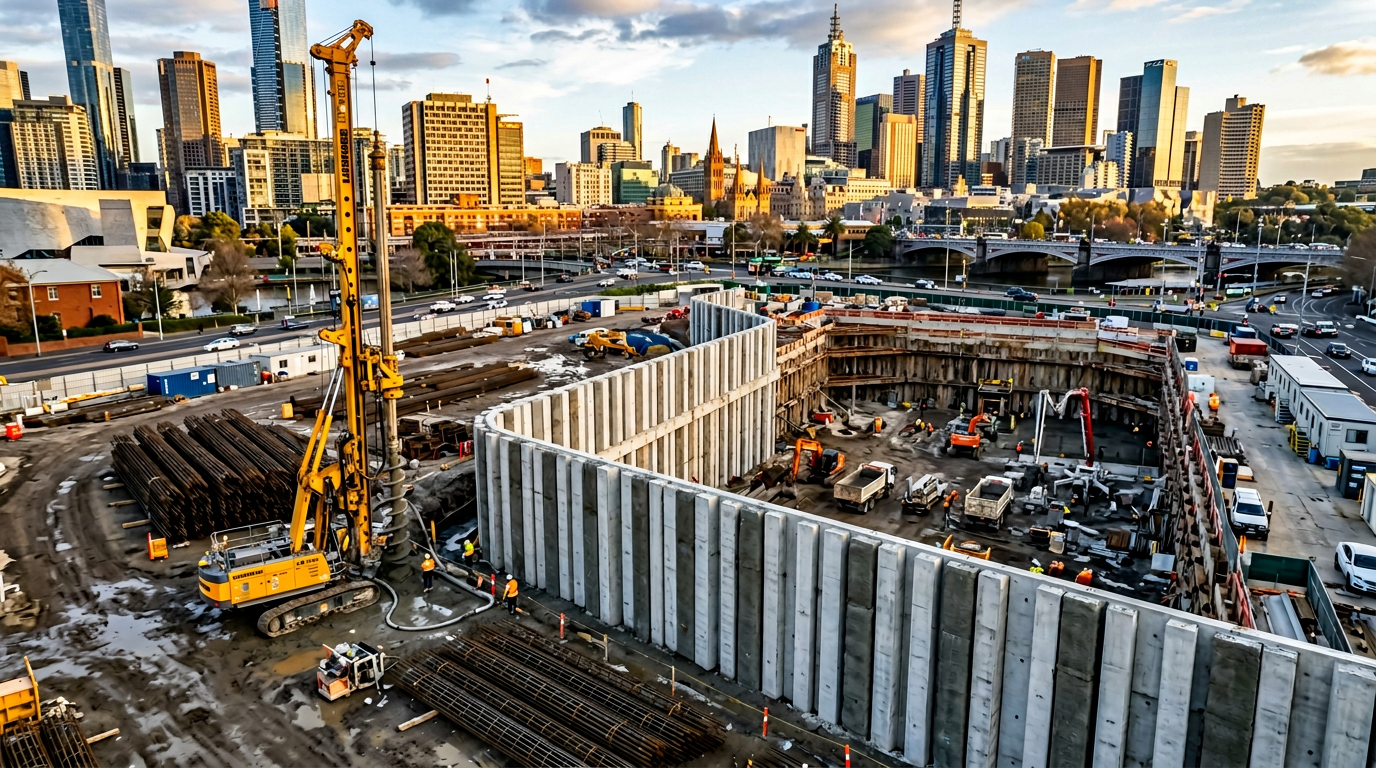
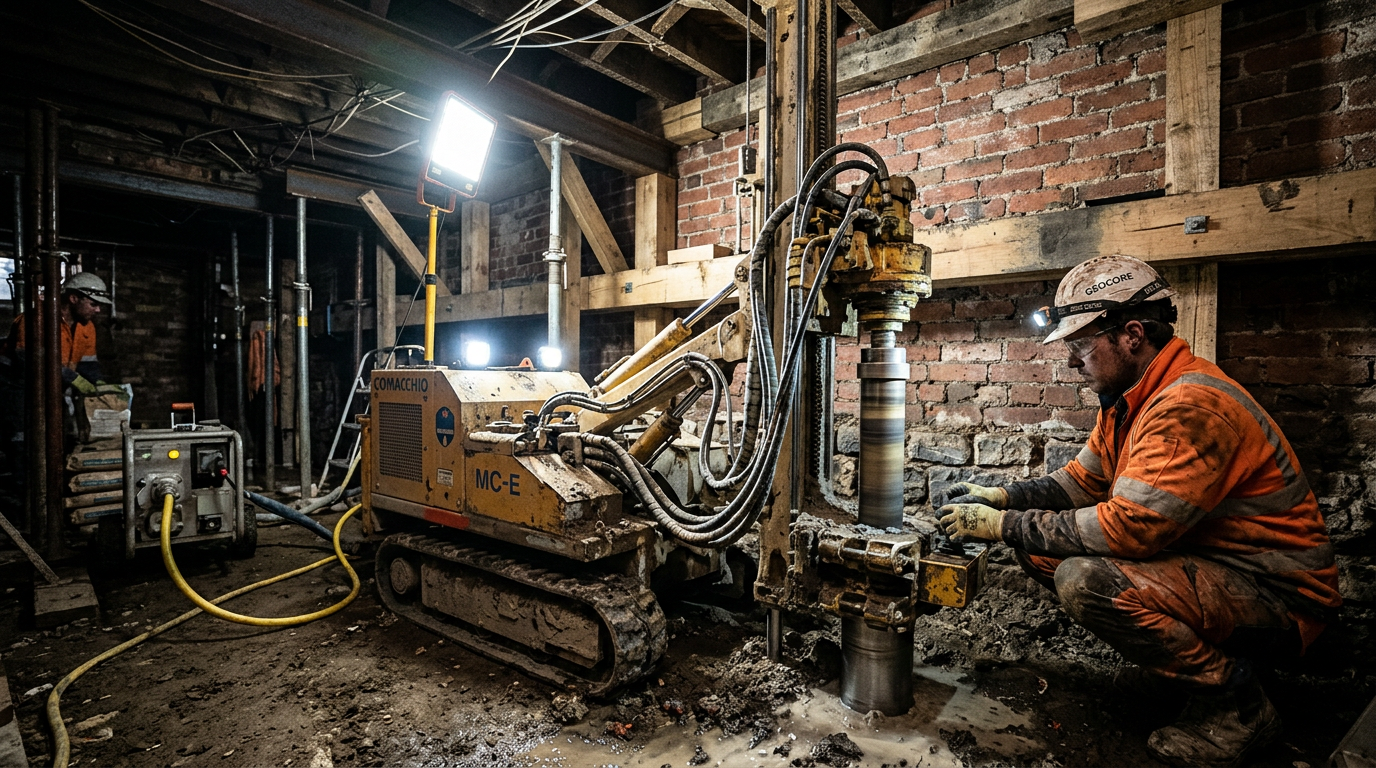
Open greenfield → good rate. Inner-city site with overhead tram wires, 3 m setback from a heritage wall, and a 6 am noise restriction → +25–60%.
4. Program pressure
Standard program → good rate. 6-day weeks, night shift, weather makeup days → +15–35%.
5. Contamination and live-plant interfaces
Clean greenfield → standard spoil disposal. Brownfield with PFAS or hydrocarbon contamination → spoil handling becomes a major line item. Live-plant interface (substation, refinery, gas plant) → permit-to-work overhead, escort requirements, constrained working hours.
6. Load testing program
Standard AS 2159 statistical testing → 1–2 dynamic tests, negligible overhead. Static load test on a sacrificial pile → $60k+ just for the test rig assembly. O-cell on a 1,200 mm pile → $150k+ plus a sacrificial pile.
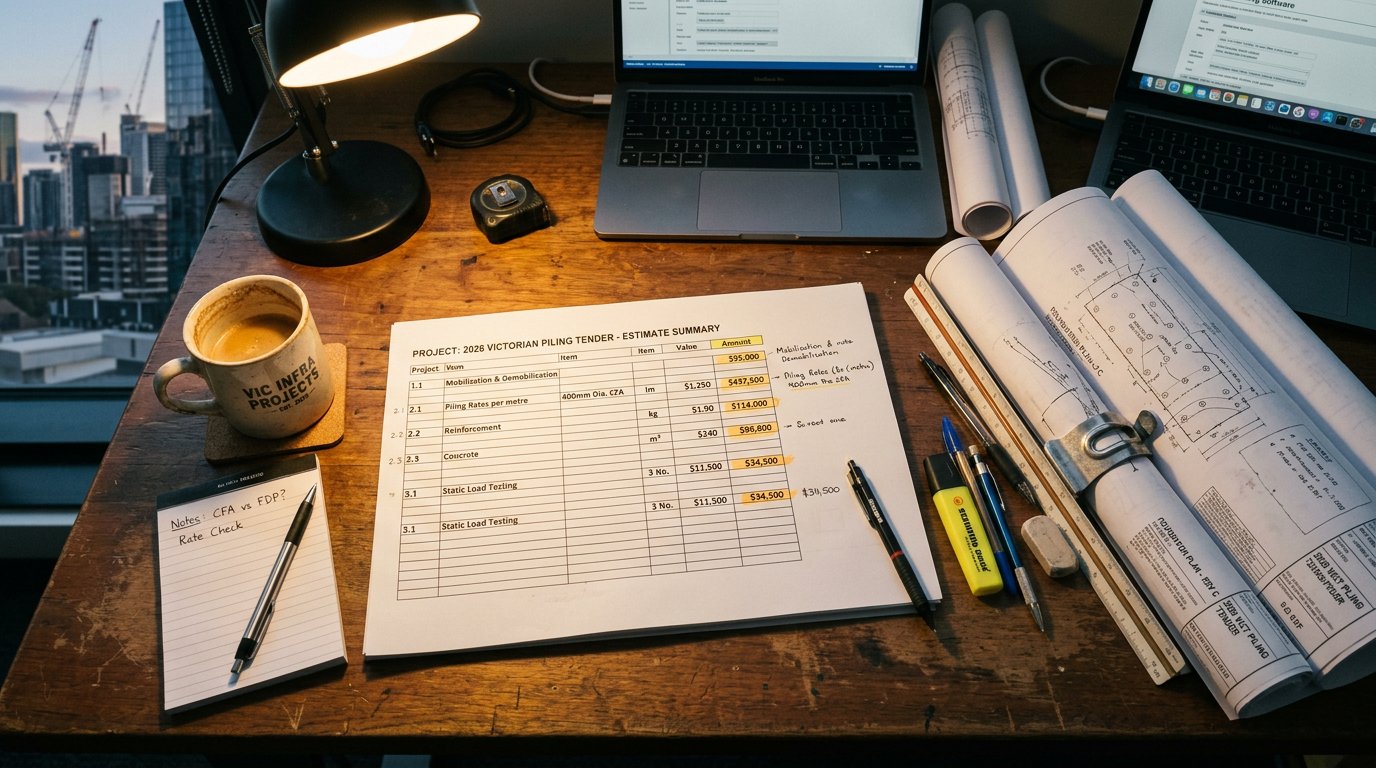
Pricing a tier-1 civil project — a worked example
50 piles × 900 mm × 20 m rock-socketed bored piers, regional Victoria, tight-program, one dynamic PDA test.
| Line item | Unit | Quantity | Rate | Cost |
|---|---|---|---|---|
| Mobilisation | LS | 1 | $18,000 | $18,000 |
| Bored pier, 900 mm, 0–15 m in clay | lm | 750 | $1,050 | $787,500 |
| Bored pier socket, 900 mm, 15–20 m in rock | lm | 250 | $1,550 | $387,500 |
| Reinforcement (0.6 t/pile) | t | 30 | $2,100 | $63,000 |
| Concrete supply (40 MPa, 200 slump) | m³ | 635 | $320 | $203,200 |
| CSL tubes (4 per pile, pre-install) | each | 50 | $420 | $21,000 |
| Install records and cert pack | LS | 1 | $15,000 | $15,000 |
| Dynamic PDA (1 pile) | LS | 1 | $28,000 | $28,000 |
| Demobilisation | LS | 1 | $18,000 | $18,000 |
| Subtotal | $1,541,200 | |||
| Overheads & margin (say 18%) | $277,400 | |||
| Tender total | ~$1,819,000 |
For 50 piles at 20 m each (1,000 lm), that is ~$1,820 per lineal metre all-up. The “piling only” number from the top table for this pile size is $1,050–1,450/lm. The all-up number is always substantially higher once reinforcement, concrete and testing are in.
Why our quotes can be lower
We do one thing differently: we own the rigs, the crews, the engineers, and we don’t sub out. Typical Melbourne piling margin stacking has three layers (piler + civil subbie + head contractor), each adding 10–18%. We strip two of those layers out. For similar scope and quality, we consistently come in 8–15% below the market on head-contractor tenders.
For the fine-print detail on what we do and don’t include, see our AS 2159 compliance pack article.
Get a real number
These are order-of-magnitude rates. Every job has its own ground profile, program, access and test regime. For a project-specific quote, send drawings to estimating — we come back same business day with an itemised rate and the exclusions in writing.
References
- Rawlinsons, Australian Construction Handbook 2026 (general civil cost benchmarks).
- Standards Australia, AS 2159:2009 Piling — Design and Installation.
- VIC PILING internal 2024–2026 project cost database.
VIC PILING is a specialist piling contractor delivering tier-1 civil, energy, rail and commercial foundations across Victoria since 2016. Our principals bring 30+ years of combined design, installation and compliance experience under AS 2159, AS 5100 and AS 4678.