The western suburbs of Melbourne — Tarneit, Truganina, Werribee, Melton, Sunbury — sit on some of the most reactive soils in Australia. Classifying a site as H1, H2 or P under AS 2870 is the default, not the exception. For civil and commercial piling this matters because the clay does not sit still. It swells up to 80 mm when it wets and shrinks the same amount when it dries. A pile that ignores this will work fine for one dry summer and then crack the structure above it in the following wet winter.
Here is what the design has to account for.
1. Why Melbourne basalt weathers this way
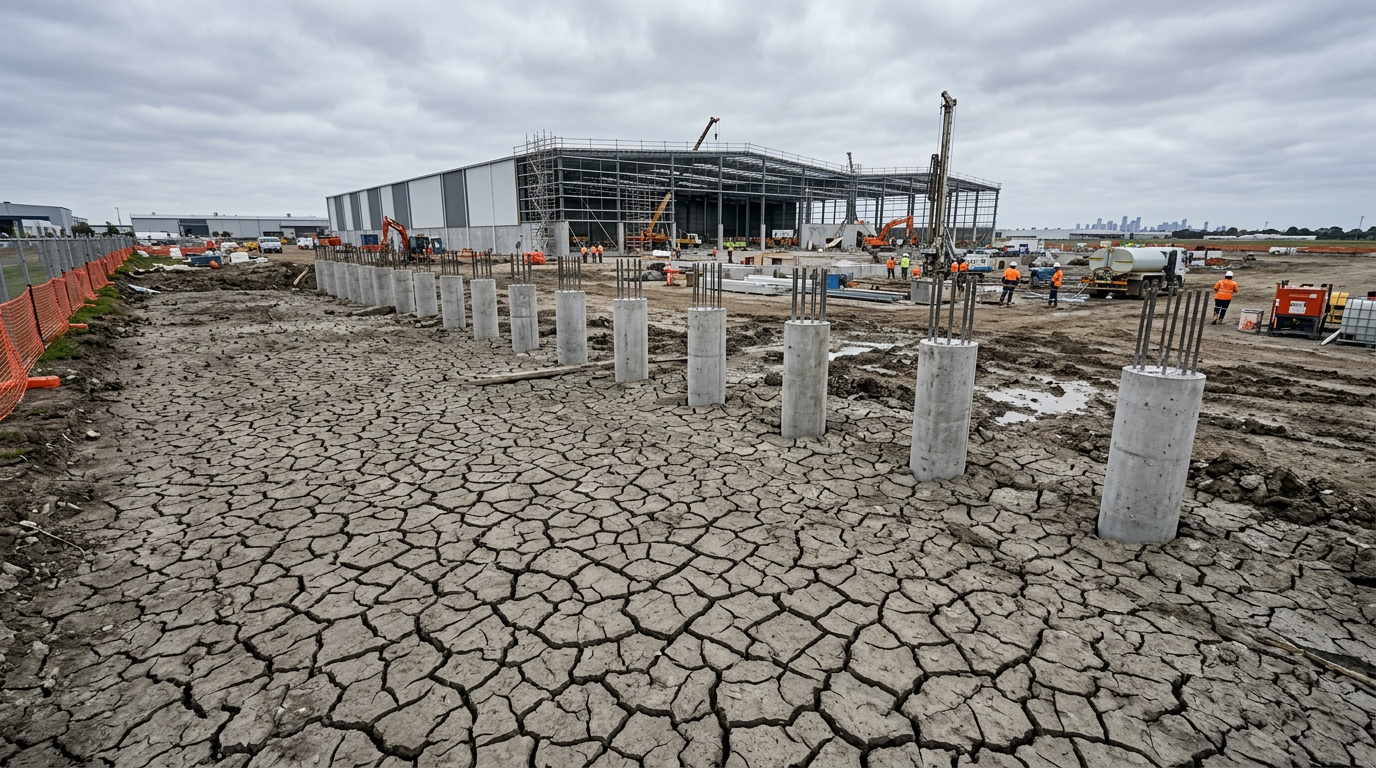
The Newer Volcanics basalt across Melbourne’s western plain is around one to two million years old. Where it has weathered in place, it produces a clay dominated by smectite and illite — the two clay minerals most prone to absorbing water between their crystal layers. The result is classic black-cracking “vertisol” clay: 1–3 m thick, sitting directly on fresh basalt bedrock, with visible polygonal cracks at the surface in summer.
The reactive zone — the depth over which moisture changes cause volume change — is typically 2 to 4 m in Melbourne’s west. Below that, moisture is effectively stable.
2. The swell-shrink force on a pile
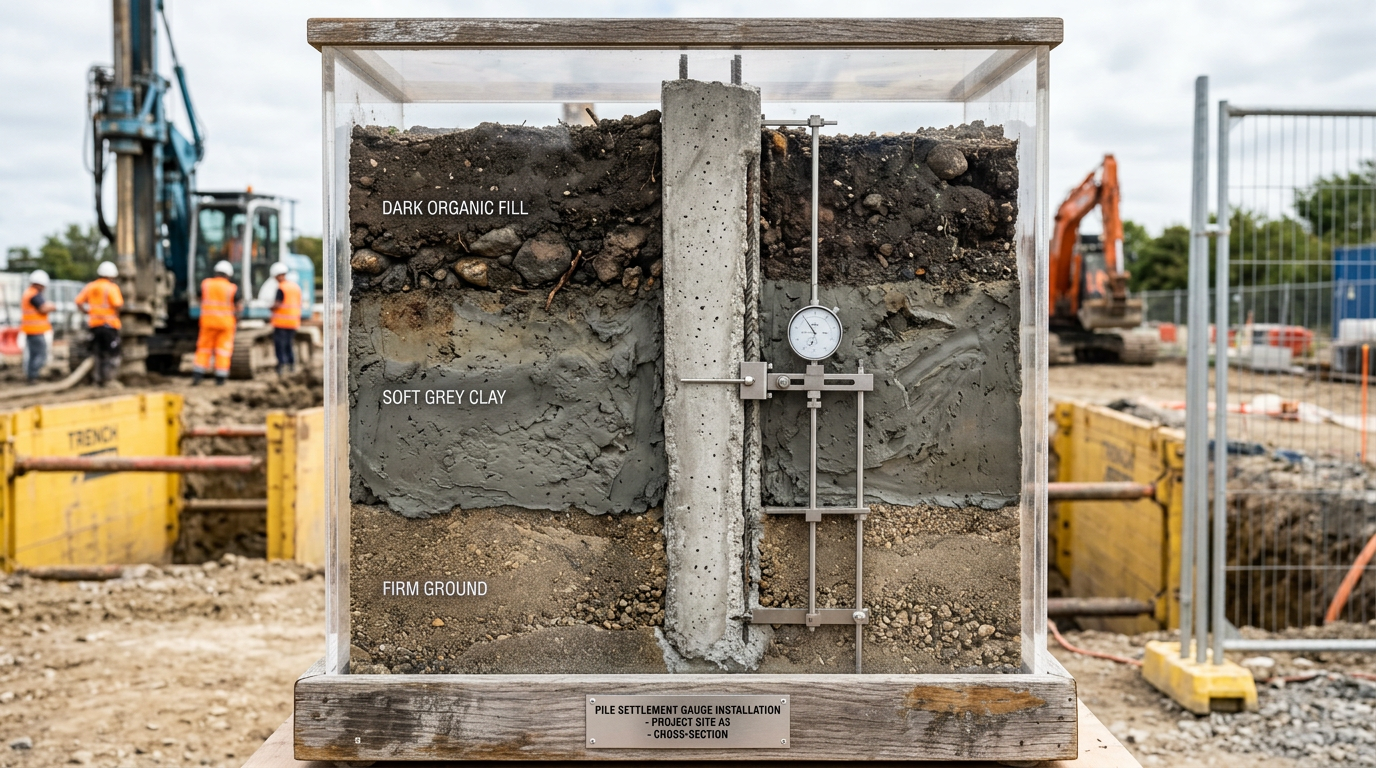
As reactive clay wets from the surface, it swells upwards — but because the deeper clay and rock are stiff, the swelling force expresses itself as uplift on the pile shaft. The same mechanism runs in reverse during drying — the clay contracts and the pile shaft is left holding the upper soil column in suspension (downdrag).
A reasonable design uplift for a pile in Class H reactive clay is 60–80 kPa of swelling shaft friction over the upper 2–4 m. On a 600 mm diameter pile that is up to 600 kN of uplift from the top 4 m alone.
If the pile is not designed for this, one of two things happens:
- The pile cap and the slab above lift with the pile, cracking internal walls.
- The reinforcement in the shaft fails in tension at the neutral axis, and the pile separates from itself.
Neither outcome is cheap to fix.
3. Four design approaches that work
3.1 Socket the pile into non-reactive ground, then isolate the reactive zone
The safest and most common approach: extend the pile 3 m or more into competent non-reactive ground (usually the underlying basalt) and sleeve the reactive upper zone with a smooth, low-friction material — typically a polyethylene “bond breaker” cast around the shaft.
Effect: the reactive clay swells and shrinks around a smooth surface with effectively zero shaft friction. The load is carried entirely by the non-reactive portion.
Trade-off: costs more per pile; requires accurate rock depth from the geotech.
3.2 Reinforce the shaft to take the tension
Where sleeving is impractical, detail the pile reinforcement to carry the full design uplift in tension. AS 3600 cover requirements apply — corrosion is a long-term concern on tension-cracked concrete.
Effect: the pile uplifts with the clay but the structure above is isolated by the pile cap detail.
Trade-off: heavier reinforcement, tighter cover tolerances.
3.3 Load the pile so compressive dead-load exceeds swell uplift
On heavily loaded piles (process platforms, tank foundations) the compressive dead-load can exceed the uplift from swelling. No special detailing needed beyond normal design.
Trade-off: only applies to heavily loaded elements. Does not help with lightly loaded verandah footings or piers under slab-on-ground edges.
3.4 Stiffen the slab to bridge the ground movement
A waffle raft or stiffened slab on ground can bridge across the reactive zone without transferring movement to the structure. This is the AS 2870 residential approach — not usually applicable to civil piling but referenced here because the ground mechanic is the same.
4. The Melbourne-specific pitfalls
Variable rock depth
The top of basalt fluctuates 2–4 m within a single footprint. Pile lengths need to be nominated as minimum embedment into fresh basalt — not a fixed depth. A flat “6 m deep” spec across a 40-pile pad guarantees a handful of over-length piles and a handful that never reach rock.
Drying out during construction
Stockpiles and unshaded earthworks desiccate the surface. By the time the piling rig arrives, the ground is 100 mm shrunk from its neutral moisture state. Piles installed then get compressed by the swelling as the site re-wets under the finished slab.
Trees on boundary
A single mature eucalyptus can dry the soil to 3 m depth across a 10 m radius. If the tree is scheduled for removal, the reactive zone will rewet and swell. Pile design must assume the post-removal moisture state.
Site-class creep
Reactive-clay sites sometimes report as H1 in the summer and H2 or P in the winter because the in-situ moisture used for the classification changes. Insist on an in-situ suction measurement, not just an Atterberg index.
5. What we recommend on every reactive-clay site
- Geotechnical investigation with in-situ moisture/suction to 4 m. Not just Atterberg limits on bagged samples.
- Probe ahead on every pad. Confirm top-of-basalt before production piling starts.
- Bond-breaker sleeving through the reactive zone on all working piles.
- Socket the pile at least 1.5 diameters into fresh basalt.
- Reinforce for the residual uplift even with a sleeve — sleeves are never perfectly frictionless.
- Monitor for a full wet-dry cycle on critical structures. Survey-mark the pile caps and read them quarterly for the first year.
6. The bottom line
Reactive clay is not a reason to avoid piling — it is a reason to engineer the pile properly. Ignore it and your piles will lift the slab. Engineer for it and they will sit dead still through a hundred wet winters.
Designing on reactive Melbourne ground? Send the geotech to info@vicpiling.com.au or call 0466 651 881 for a second-opinion review.
References
- Standards Australia, AS 2870:2011 — Residential Slabs and Footings.
- Standards Australia, AS 2159:2009 — Piling: Design and Installation.
- Standards Australia, AS 1726:2017 — Geotechnical Site Investigations.
- Geological Survey of Victoria, Geology of Melbourne — Urban Geology Series.
- Fityus, S., Smith, D. & Allman, M. (Eds.), Expansive Soils — Recent Advances in Characterization and Treatment, 2005.
Article technically reviewed by a chartered civil/geotechnical engineer (CPEng, MIEAust) with specific Melbourne reactive-clay experience.
VIC PILING is a specialist piling contractor delivering tier-1 civil, energy, rail and commercial foundations across Victoria since 2016. Our principals bring 30+ years of combined design, installation and compliance experience under AS 2159, AS 5100 and AS 4678.