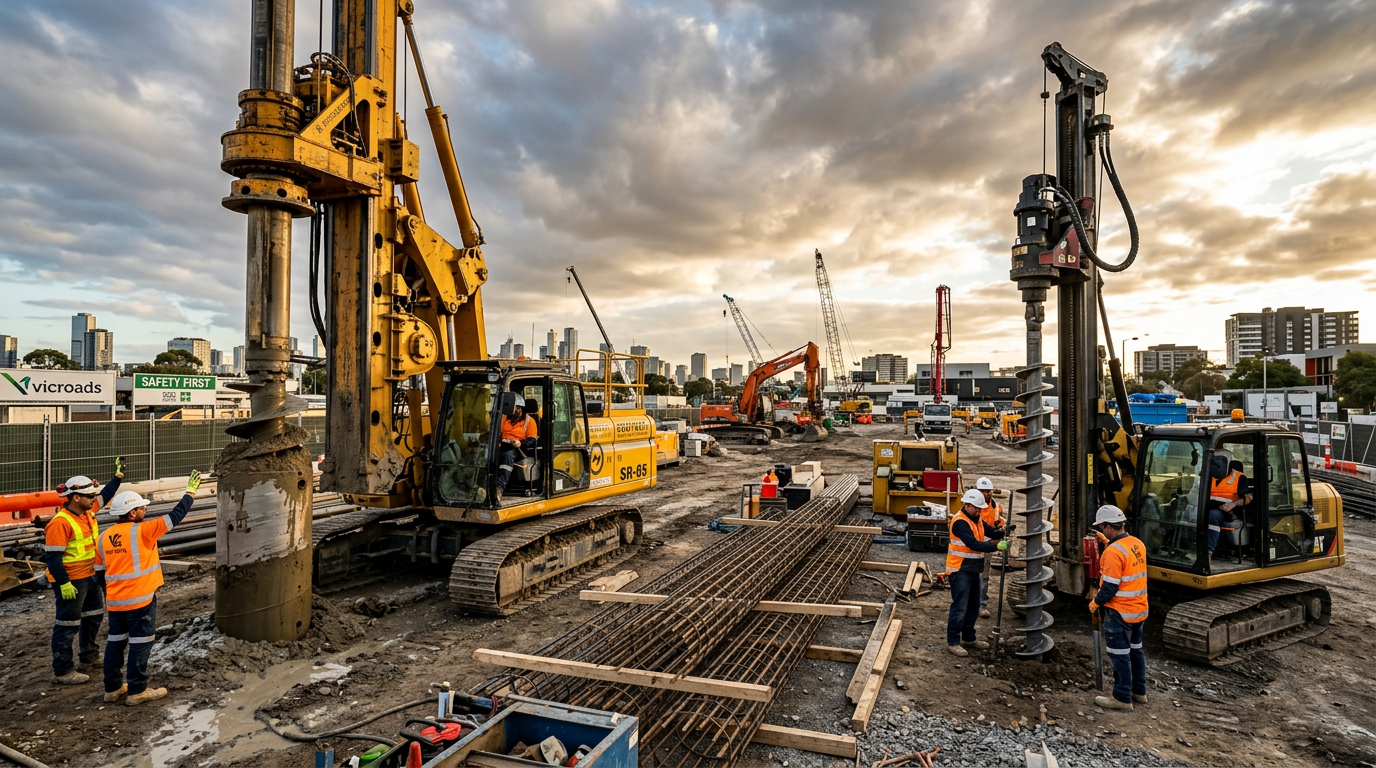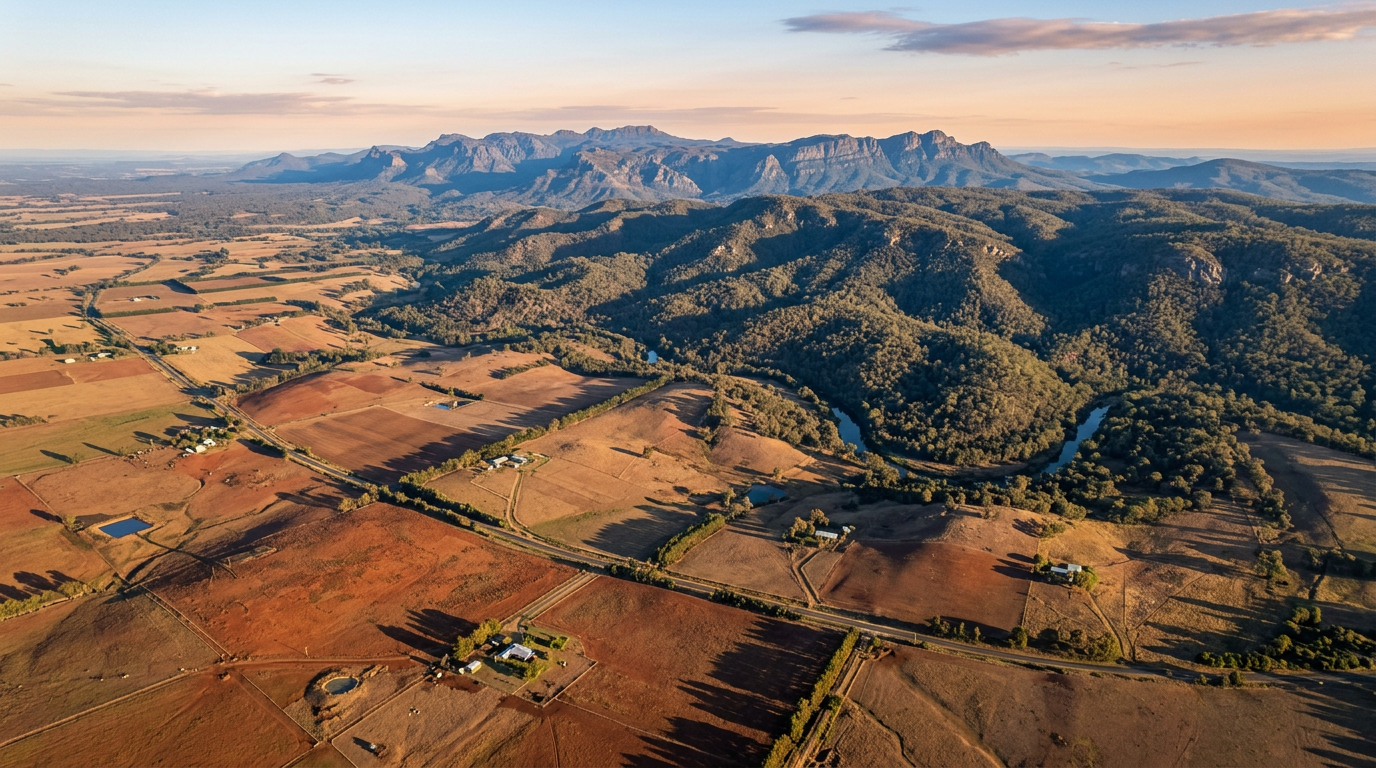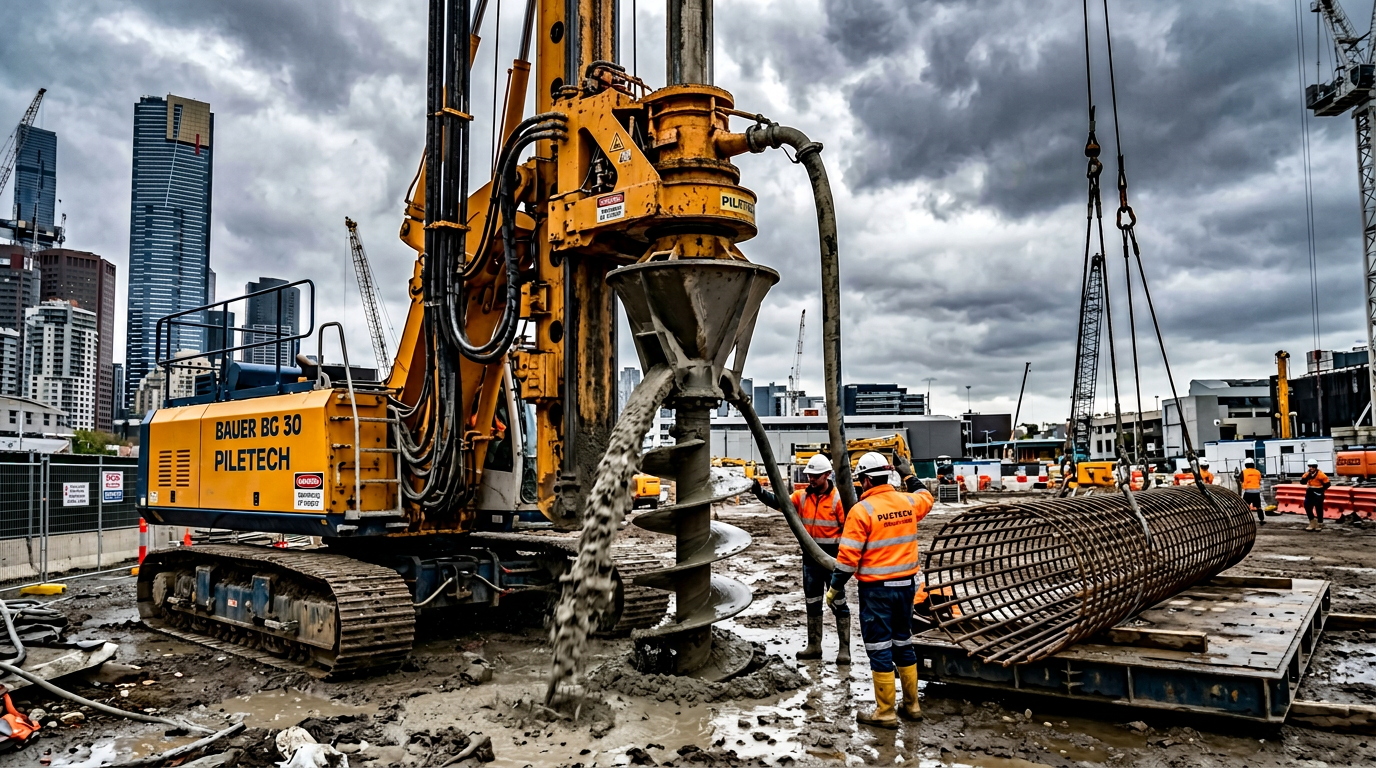
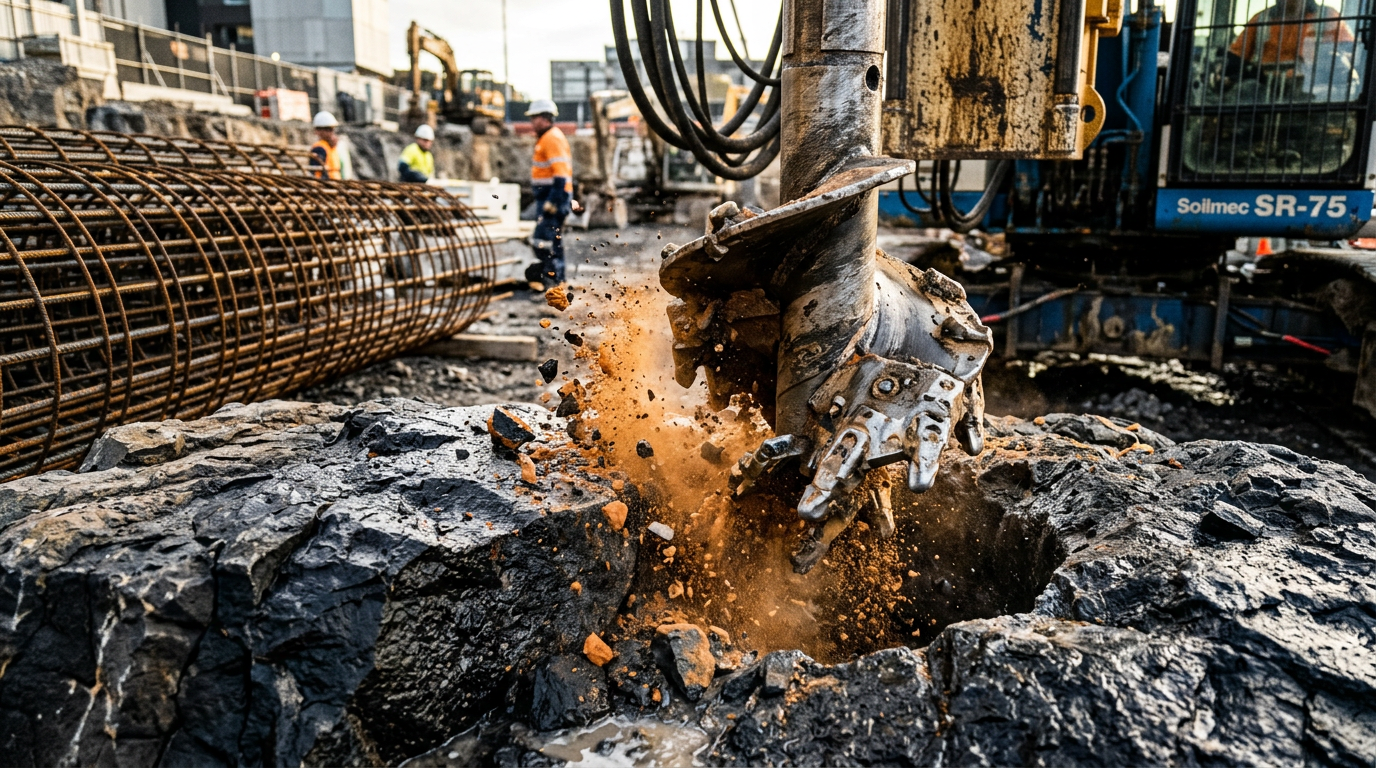
“Rock-socketed” is a phrase that does a lot of heavy lifting on Victorian civil drawings. The trouble is that rock in Victoria is not one thing. It is weathered Silurian mudstone in the east, competent Newer Volcanics basalt under Melbourne’s western plain, granite batholiths through the northeast, and metasediments across the Grampian belt. Each one takes a different tool, a different socket length, and a very different verification approach.
This is the engineer’s version of what actually happens when you socket into Victorian rock.
1. What “rock socket” means in AS 2159
A rock socket is the portion of a bored pier that is drilled into competent rock below the weathered overburden. Its purpose is to mobilise shaft friction and end bearing on a stratum whose strength is an order of magnitude higher than the soil above.
AS 2159 does not prescribe a minimum socket length. The design sets it based on:
- Required geotechnical capacity (ultimate shaft friction × socket surface area + end-bearing × base area).
- Unconfined compressive strength (UCS) of the founding rock.
- Rock mass quality (RQD, joint sets, weathering grade).
- Socket roughness — the rougher the socket wall, the higher the mobilised shaft friction.
A typical minimum-effective socket for a commercial bored pier in Melbourne basalt is 1.5 to 3.0 diameters. For a bridge pier on strong basalt, you may see 3 to 6 diameters because AS 5100 tightens Φg.
2. The five rocks you will meet in Victoria
2.1 Newer Volcanics basalt — the Melbourne western plain
- Where: from the CBD out to Werribee, Melton, Sunbury, north-west into Bacchus Marsh. Across the basalt plain most of the way to Ballarat.
- UCS (fresh): 80–200 MPa. It is hard rock.
- The catch: the contact surface undulates. Twelve metres of basaltic clay in borehole BH-1 can become three metres in BH-2 twenty metres away. Socket depths must be specified as a minimum embedment below “top of fresh/slightly weathered basalt confirmed by inspection”, not as a fixed RL.
- Tooling: rock auger with carbide or TCI teeth, clean-out bucket to finish the base.
2.2 Older Volcanics basalt — south-east Melbourne, Gippsland margin
- Where: patches through Dandenong, Berwick, Cranbourne; widespread through South Gippsland.
- UCS: 50–150 MPa, often with interbedded scoria and ash layers.
- The catch: scoria voids at the founding depth. A socket into a 500 mm scoria band will not verify.
2.3 Silurian mudstone and sandstone — east and north Melbourne
- Where: Kew, Ivanhoe, Doncaster through the eastern foothills.
- UCS (fresh): 20–60 MPa. “Medium strength” to “strong” rock.
- The catch: slakes rapidly when wet. If the socket base sits exposed overnight in the rain, capacity drops. Pour the same shift, or protect the base with a polythene cap and re-clean before concrete.
2.4 Granite and granodiorite — north-east Victoria
- Where: Strathbogies, Beechworth, Mount Buffalo, parts of the Central Highlands.
- UCS: 150–250 MPa. Very hard.
- The catch: jointed. Solid-looking borehole core can hide 200 mm joint infill of clayey material. Specify minimum RQD alongside the UCS.
- Tooling: down-hole hammer (DHH) for small-diameter sockets; heavy rotary with TCI rock auger for large diameters.
2.5 Metasediments and quartzite — Grampians, Pyrenees
- Where: western and north-west Victorian ranges.
- UCS: highly variable — 30 to 300 MPa within the same site.
- The catch: anisotropy. Shaft friction along the bedding is much lower than across it. Orient socket roughness grooves perpendicular to bedding where you can.
3. Specifying the socket — what the drawings should say
A good rock-socket specification has five lines:
- Minimum embedment below a described founding horizon — for example, “3.0 m minimum embedment into fresh to slightly weathered basalt (W1–W2)”.
- Minimum founding-rock UCS — for example, “founding rock UCS ≥ 80 MPa confirmed by core or rebound hammer”.
- Minimum RQD in the socket zone — usually ≥ 50% for large-diameter bored piers.
- Socket-wall roughness — a line saying the socket shall not be cased and shall be cleaned by clean-out bucket, with socket-wall grooves permitted or required.
- Acceptance criterion — what the site engineer signs off against at each pier.
A drawing that simply says “socket 2 m into rock” is not a specification. It is a wish.
4. Verifying the socket in the field
Four tools, in order of preference:
- Inspection — camera or down-hole observation. For large-diameter piers (≥ 1200 mm) a geotechnical engineer can physically inspect the socket base with a camera or, for the largest, a bell-caged descent.
- Continuous drilling records. Rate of penetration and hydraulic pressure on the rotary head correlate with rock strength. Every modern rotary rig logs this. A rate-of-penetration plot against depth is one of the fastest ways to show the socket is in the specified stratum.
- Rebound hammer on retrieved spoil. Crude, but useful when an inspection window is not feasible. A Schmidt hammer reading on fresh cuttings compared against borehole core gives a sanity check.
- Statnamic or dynamic (PDA) test. For critical piers or where design is tight, a high-strain dynamic test confirms capacity within 48 hours of install.
5. The three most expensive mistakes
- Not probing ahead. Every pier should have a probe hole to confirm rock depth before the production auger runs. Melbourne’s basalt contact can vary by 3 m in 5 m of plan.
- Pouring a dirty socket. Spoil left on the base reduces end-bearing dramatically. Clean-out bucket, tremie pour, then cage.
- Casing the socket. A permanent casing through the socket destroys shaft friction. The casing must stop at top-of-rock unless the design explicitly discounts socket friction.
6. What we ask for on a new rock-socketed project
If a consulting engineer sends us a bored pier drawing with rock sockets, we need four things before we mobilise:
- Geotechnical investigation report with rock core photos or UCS tests at socket depth.
- Pile schedule with individual pier capacities and socket depths.
- Acceptance criteria for each founding horizon.
- Access for a probe-hole rig ahead of production drilling.
Give us those four, and we will deliver pile records that survive any auditor.
Need a rock-socketing review on your drawings? Send them to info@vicpiling.com.au or call 0466 651 881.
References
- Standards Australia, AS 2159:2009 — Piling: Design and Installation (rock socket guidance).
- Rowe, R. K. & Armitage, H. H., “A design method for drilled piers in soft rock”, Canadian Geotechnical Journal, 24(1), 1987, pp. 126–142.
- Kulhawy, F. H. & Phoon, K.-K., “Drilled shaft side resistance in clay soil to rock”, ASCE Geotechnical Special Publication, 1993.
- Pells, P. J. N., Rowe, R. K. & Turner, R. M., “An experimental investigation into side shear for socketed piles in sandstone”, Proc. International Conference on Structural Foundations on Rock, Sydney, 1980.
- Geological Survey of Victoria, The Newer Volcanics of the Western Plains — basalt distribution and engineering geology.
Article technically reviewed by a chartered geotechnical engineer (CPEng, MIEAust) with Victorian basalt and granite socketing experience.
VIC PILING is a specialist piling contractor delivering tier-1 civil, energy, rail and commercial foundations across Victoria since 2016. Our principals bring 30+ years of combined design, installation and compliance experience under AS 2159, AS 5100 and AS 4678.