If you spent the last decade in metropolitan Melbourne you could be forgiven for thinking driven piles had quietly gone extinct. The reality is they never did — they just moved out of town. Driven precast concrete piles still dominate foreshore work, port maintenance, bridge construction in regional Victoria, and any greenfield project where vibration is acceptable and production rate governs. This article sets out where driven precast still wins, how they are designed, and why specifying them correctly matters.
Why displacement piles persist
A driven precast pile is a displacement pile — soil is pushed aside, not removed. That single fact gives them four practical advantages over any replacement pile (bored, CFA, secant):
- Ground improvement, for free. The soil displaced by driving densifies in place. For loose-to-medium-dense sands, the pile installation itself improves the surrounding ground by 10–30% in SPT N. A group of driven piles in loose sand ends up with pile capacities significantly higher than predicted by single-pile theory.
- Factory-cast quality. The pile is manufactured in a precast yard under controlled conditions: fixed mix, fixed reinforcement placement, 28-day curing prior to shipment. The concrete you put in the ground is the concrete you designed — not the concrete that the batch plant delivered at 3 pm on a hot day in January.
- Immediate dynamic capacity check. Every pile gets a set check as it’s driven. The blow count on the last metre of driving is a real-time capacity indicator (Hiley formula or a more rigorous wave-equation analysis). A bad pile reveals itself before the next pile is started. There is no CFA equivalent.
- Production rate. A modern hydraulic hammer + experienced crew will drive 20–40 piles per day of 300 mm × 15 m length in competent sandy ground. That is 2–4× the rate of equivalent bored piers.
When driven precast is the right answer
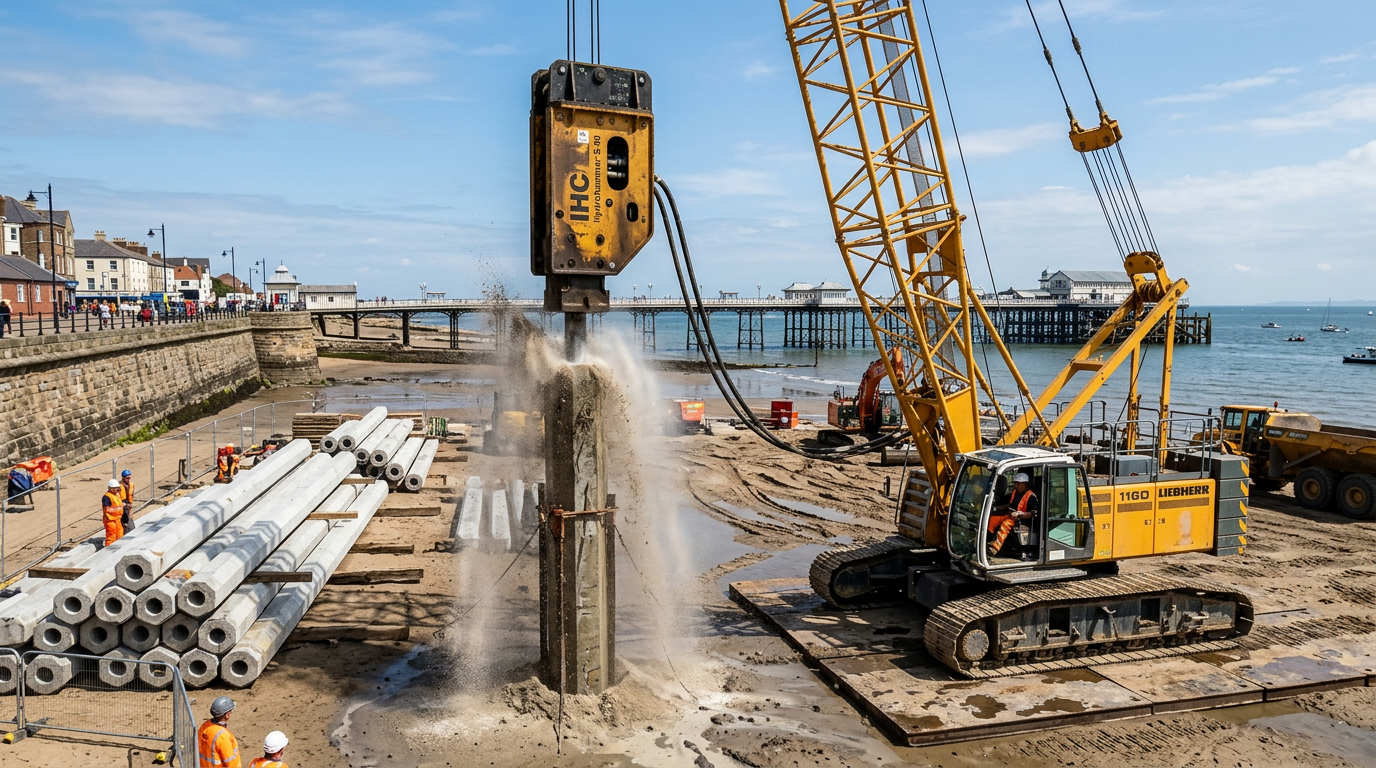
Marine and foreshore. Foreshore work in Port Phillip Bay, Western Port, Gippsland Lakes, the Geelong waterfront, and any pile-supported jetty or wharf. The ground is almost always granular, headroom is either unlimited (barge-mounted) or tight (existing structure above), and vibration limits are governed by marine ecology rather than adjacent structures.
Bridge piers in alluvial floodplains. Many Victorian bridge projects on regional roads sit in alluvial gravels — the Goulburn, Ovens, Murray, Yarra floodplains. Driven precast piles perform extremely well here, and a modern crawler crane + hydraulic hammer delivers a clean, fast, inspectable installation.
Port and coastal infrastructure. Container terminal expansions, grain terminals, oil and gas berths. Driven steel-tube piles often dominate here, but precast concrete still competes favourably where durability in splash-zone exposure is the governing criterion.
Greenfield commercial. Large greenfield industrial estates on the outer Melbourne fringe — Truganina, Derrimut, Laverton North — have the space, the ground, and the tolerance for vibration that driven precast needs. 400 piles in a week is common.
When driven precast is the wrong answer
- Inner metropolitan Melbourne. Noise and vibration limits (see our vibration limits article) are usually incompatible with impact-driven installation.
- Soft cohesive ground. Very soft clays can cause “soil heave” during driving — displaced soil lifting the ground and pre-driven piles. Rate of driving must be controlled; group effects matter.
- Hard rock founding. Precast concrete can’t penetrate competent rock. If the design requires a rock socket, driven is out.
- Obstructed ground. Boulders, buried fill, old foundations — driven piles fracture or deflect on contact. Pre-bore or switch to bored.
- Sites adjacent to sensitive equipment. Instrumented buildings, hospitals with MRIs, data centres — the peak particle velocity from even moderate driving can exceed equipment tolerances.
Design basics — the pile as a concrete column in the ground
Precast concrete piles are designed to two limit states: transport/handling and driving stress, on top of the in-service loads. For a typical 350 mm square precast driven pile:
- Concrete strength. f’c = 50 MPa at transport, 65 MPa at driving. Early-strength mixes with Type HE cement are common.
- Longitudinal reinforcement. 4 × N24 bars typical. Reinforcement ratio ≥ 0.8% for pick-up handling; 1.0–1.5% for driving stresses.
- Spiral reinforcement. Close-pitch helical R10 at 75 mm centres over the top 3 pile-diameters and the bottom 3 pile-diameters; 150 mm centres in between. This confines concrete against the splitting-stress wave that travels down the pile during each hammer blow.
- Concrete cover. 50 mm minimum, 65 mm in splash zone, 75 mm for aggressive marine.
- Pile head reinforcement. Additional top layer of spiral, often with a bonded steel driving helmet. Spalling at the head is the single biggest failure mode during driving.
Dynamic capacity verification
Every driven pile gives you a free capacity check via the blow count during final driving. AS 2159 Clause 5.4 recognises dynamic load testing (PDA — Pile Driving Analyzer) as an acceptable method for verifying ULS geotechnical capacity.
A best-practice driven-pile QA package:
- Wave-equation analysis (WEAP) before production — Smith model, pile + hammer + cushion + soil quakes/damping. Predicts the blow count for the design capacity.
- PDA on the first 5–10% of piles — full instrumentation on the pile head, strain and acceleration traces on every hammer blow for a calibration pile. Signal-matching (CAPWAP) gives dynamic shaft and toe capacities.
- Set criterion on every production pile — driving resistance (typically blows per 100 mm) on the last 300 mm of driving. Derived from the WEAP + PDA calibration. A crew can achieve this in the normal driving sequence without stopping.
- Restrike testing — redriving a pile 24–48 hours after initial driving to measure set-up (capacity gain over time as excess pore pressures dissipate).
See our pile load testing guide for more on dynamic testing methods.
Typical driven-pile schedule — what a full tender looks like
A typical bridge-pier tender for 40 × 350 mm square precast driven piles at 18 m in alluvial sand would price roughly:
- Precast supply (factory-cast, delivered to site) — ~$620/lm (2026 pricing).
- Driving (hydraulic hammer, lattice crawler crane, crew of 4) — ~$180/lm.
- WEAP + PDA calibration — lump-sum, $15–30k.
- Set checks — negligible (crew in normal driving sequence).
- Final report — lump-sum, $8–15k.
Total roughly $820/lm delivered and tested. For comparison, a 450 mm CFA pile in the same ground prices at ~$680/lm without the immediate dynamic capacity verification. See our piling cost guide for the full breakdown.
What goes wrong
- Under-reinforced pile head. Spalling from the top down during the first 5 blows. Usually means the driving helmet or cushion is wrong for the hammer energy.
- Excessive tension stresses. Pile going through soft layer into hard layer can throw tension waves that crack the shaft. Mitigation: larger cushion, stiffer hammer, slower driving.
- Uplift during pile group driving. Driving sequence matters. In soft clay, drive from the centre outwards; in sand, drive in straight rows to let pore pressures dissipate.
- Obstruction strike. Pile fractures on contact with a buried boulder. Pre-boring a 300 mm hole through the top 2–3 m is cheap insurance.
- Alignment drift. A 1:100 out-of-plumb at 18 m is 180 mm at toe. Good driving practice and verticality monitoring keep this under control.
References
- Standards Australia, AS 2159:2009 Piling — Design and Installation.
- Standards Australia, AS 5100.3:2017 Bridge design — Foundations and soil-supporting structures.
- Hannigan P.J. et al., Design and Construction of Driven Pile Foundations, FHWA-NHI-16-009 (Vols I and II), 2016.
- Smith E.A.L., Pile-Driving Analysis by the Wave Equation, ASCE Journal of Soil Mechanics, 1960.
VIC PILING is a specialist piling contractor delivering tier-1 civil, energy, rail and commercial foundations across Victoria since 2016. Our principals bring 30+ years of combined design, installation and compliance experience under AS 2159, AS 5100 and AS 4678.